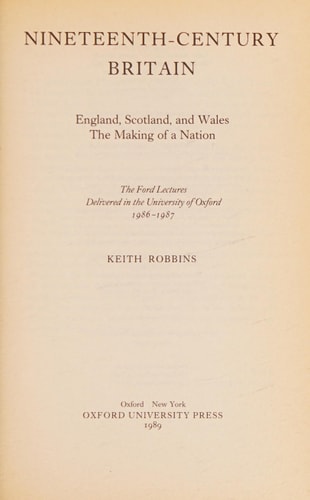
Nineteenth-Century Britain: England, Scotland and Wales: The Making of a Nation
0
0
As an Amazon Associate and affiliate partner, Menrva Books earns from qualifying purchases. Learn more
Author Description
While nineteenth-century Britain was committed to achieving national integration, it also hoped to maintain regional diversity. Keith Robbins looks at various aspects of life which served to unite or divide the nation, including religion, patterns of eating and drinking, the political system, commercial development, education, language, literature, and music. He concludes that the "British" nation, though not uniform in character, became sufficiently consolidated throughout the nineteenth century to withstand the divisive crises of the early twentieth century, particularly World War I. A stimulating account of the making of the modern British nation, this study is of continuing relevance today.
Menrva's Summary
THE THESIS
This study investigates the complex tension between national integration and regional diversity in nineteenth-century Britain. Keith Robbins, a historian specializing in British history, utilizes a broad range of cultural and political data to argue that the British nation achieved a level of consolidation that allowed it to survive the geopolitical pressures of the early twentieth century. The author examines how disparate elements of life, from religious practice to commercial development, functioned as both unifying and divisive forces across England, Scotland, and Wales.
THE SCOPE MAP
What You Will Find
- Analysis of national integration versus regional identity in England, Scotland, and Wales
- Examination of social factors including religion, diet, and education
- Assessment of political and commercial systems as drivers of national unity
- Evaluation of cultural markers such as language, literature, and music
Scope Limits
- Does not provide an exhaustive military history of the period
- Focuses primarily on the internal social and political cohesion of the British state rather than international colonial policy
THE AUTHORITY PERSPECTIVE
Experts recognize this work as a comprehensive synthesis of the social and political forces that shaped modern Britain. Readers frequently note the academic density of the prose, which provides a detailed framework for understanding the consolidation of the British nation.
Page Count:
208
Publication Date:
1989-06-01
Publisher:
Oxford University Press
ISBN-10:
0192851225
ISBN-13:
9780192851222
History
Cultural History
Political History
Sociology
Regionalism
British History
19th Century
Great Britain
Community Tags
Similar Books