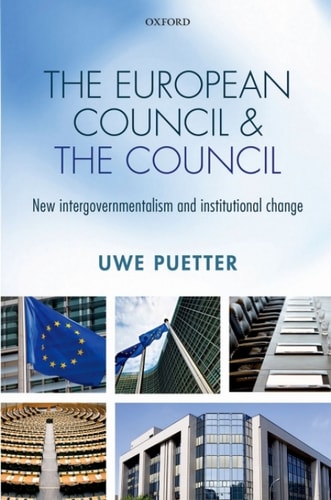
The European Council and the Council: New Intergovernmentalism and Institutional Change
0
0
As an Amazon Associate and affiliate partner, Menrva Books earns from qualifying purchases. Learn more
Author Description
This book offers one of the most comprehensive accounts of European Council and Council decision-making by covering two decades of European integration from the late 1990s until the years after the entering into force of the Lisbon Treaty. Case studies analyse the European Council, the Eurogroup, the Economic and Financial Affairs Council, the Foreign Affairs Council and the Employment, Social Policy, Health and Consumer Affairs Council as well as the role of senior coordination committees. Puetter provides a genuinely new perspective on the European Council and the Council, portraying the two institutions as embodying the new intergovernmentalism in European Union Governance. The European Council and the Council shows how post-Maastricht integration is based on an integration paradox. Member states are eager to foster integration but insist that this is done outside the community method. This especially applies to new prominent areas of European Union activity including economic governance, common foreign, security and defence policy as well as employment and social policy. This book explains how the evolution of these new areas triggered institutional change. Policy coordination and intergovernmental agreement are identified as the main governance mechanisms with the European Council and the Council at the centre of these processes. This book features a novel analytical framework - deliberative intergovernmentalism - to trace institutional change after the Treaty of Maastricht. Joint decision-making among member states is understood as non-legislative decision-making which is geared towards permanent consensus seeking and direct member state involvement at all stages of the policy process.
Menrva's Summary
THE THESIS
How has the evolution of the European Council and the Council shaped the trajectory of European integration since the Treaty of Maastricht? Uwe Puetter, a scholar of European integration, utilizes two decades of empirical data to examine the shift in EU governance. He argues that member states have increasingly pursued integration through intergovernmental channels rather than the traditional community method, leading to a phenomenon he terms 'deliberative intergovernmentalism.' This framework explains how permanent consensus-seeking and direct state involvement have fundamentally altered institutional decision-making processes.
THE SCOPE MAP
What You Will Find
- Analysis of the European Council, Eurogroup, and various specialized Council configurations.
- The 'deliberative intergovernmentalism' analytical framework for non-legislative decision-making.
- Longitudinal study of EU integration from the late 1990s through the post-Lisbon Treaty era.
Scope Limits
- The text does not focus on the European Parliament or the European Commission's legislative roles.
- It excludes detailed analysis of judicial processes within the European Court of Justice.
THE AUTHORITY PERSPECTIVE
Experts identify this work as a foundational text for understanding the shift toward intergovernmentalism in contemporary EU governance. Readers frequently note the academic density of the prose, which is tailored for students and researchers of political science and European studies.
Page Count:
264
Publication Date:
2014-01-01
Publisher:
OUP Oxford
ISBN-10:
0191025534
ISBN-13:
9780191025532
Governance
Public Policy
International relations
European Union
Community Tags
Similar Books