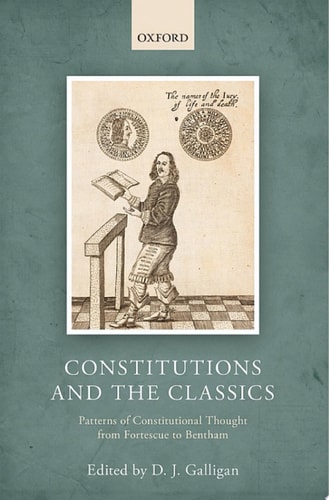
Constitutions and the Classics: Patterns of Constitutional Thought from Fortescue to Bentham
0
0
As an Amazon Associate and affiliate partner, Menrva Books earns from qualifying purchases. Learn more
Author Description
The period from the fifteenth century to the late eighteenth century was one of critical importance to British constitutionalism. Although the seeds were sown in earlier eras, it was at this point that the constitution was transformed to a system of representative parliamentary government. Changes at the practical level of the constitution were accompanied by a wealth of ideas on constitutions written from different - and often competing - perspectives. Hobbes and Locke, Harrington, Hume, and Bentham, Coke, the Levellers, and Blackstone were all engaged in the constitutional affairs of the day, and their writings influenced the direction and outcome of constitutional thought and development. They treated themes of a universal and timeless character and as such have established themselves of lasting interest and importance in the history of constitutional thought. Examining their works we can follow the shaping of contemporary ideas of constitutions, and the design of constitutional texts. At the same time major constitutional change and upheaval were taking place in America and France. This was an era of intense discussion, examination, and constitution-making. The new nation of the United States looked to authors such as Locke, Hume, Harrington, and Sydney for guidance in their search for a new republicanism, adding to the development of constitutional thought and practice. This collection includes chapters examining the influences of Madison, Hamilton, Jefferson, and Adams. In France the influence of Rousseau was apparent in the revolutionary constitution, and Sieyes was an active participant in its discussion and design. Montesquieu and de Maistre reflected on the nature of constitutions and constitutional government, and these French writers drew on, engaged with, and challenged the British and American writers. The essays in this volume reveal a previously unexplored dynamic relationship between the authors of the three nations, explaining the intimate connection.
Menrva's Summary
THE THESIS
This volume investigates the evolution of constitutional thought by analyzing the interplay between British, American, and French political philosophers from the fifteenth to the late eighteenth century. Denis J. Galligan, a scholar of law and socio-legal studies, synthesizes the writings of key figures such as Hobbes, Locke, Bentham, and Montesquieu to demonstrate how their competing perspectives shaped modern representative government. The work argues that constitutional design is not merely a product of local upheaval but a result of a cross-national intellectual dialogue that persists in contemporary political frameworks.
THE SCOPE MAP
What You Will Find
- Analysis of constitutional development from the era of Fortescue through the age of Bentham.
- Comparative study of British parliamentary evolution alongside American republicanism and French revolutionary constitution-making.
- Examination of the intellectual contributions of figures including Madison, Hamilton, Jefferson, Adams, Rousseau, and Sieyes.
Scope Limits
- The text focuses primarily on the intellectual history of constitutionalism rather than a comprehensive legal history of specific statutes.
- It does not provide an exhaustive survey of non-Western constitutional influences during this period.
THE AUTHORITY PERSPECTIVE
Scholars and legal historians frequently cite this work for its ability to bridge the gap between political philosophy and the practical application of constitutional law. Readers often note the academic density of the prose, which serves as a rigorous resource for those studying the foundational texts of Western governance.
Page Count:
455
Publication Date:
2014-01-01
Publisher:
OUP Oxford
ISBN-10:
019102550X
ISBN-13:
9780191025501
Philosophy
History
British History
Constitutional Law
Political Theory
Professional Career & Trade
Constitutional History
Community Tags
Similar Books