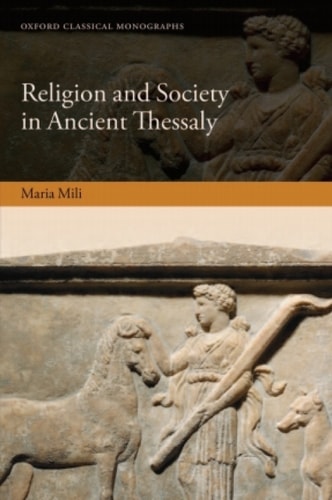
Religion and Society in Ancient Thessaly
0
0
As an Amazon Associate and affiliate partner, Menrva Books earns from qualifying purchases. Learn more
Author Description
The fertile plains of the ancient Greek region of Thessaly stretch south from the shadow of Mount Olympus. Thessaly's numerous small cities were home to some of the richest men in Greece, their fabulous wealth counted in innumerable flocks and slaves. It had a strict oligarchic government and a reputation for indulgence and witchcraft, but also a dominant position between Olympus and Delphi, and a claim to some of the greatest Greek heroes, such as Achilles himself. It can be viewed as both the cradle of many aspects of Greek civilization and as a challenge to the dominant image of ancient Greece as moderate, rational, and democratic. Religion and Society in Ancient Thessaly explores the issues of regionalism in ancient Greek religion and the relationship between religion and society, as well as the problem of thinking about these matters through particular bodies of evidence. It discusses in depth the importance of citizenship and of other group-identities in Thessaly, and the relationship between cult activity and political and social organization. The volume investigates the Thessalian particularities of the evidence and the role of religion in giving the inhabitants of this land a sense of their identity and place in the wider Greek world, as well as the role of Thessaly in the ancients' and moderns' understanding of Greekness.
Menrva's Summary
THE THESIS
How did the unique religious practices and social structures of ancient Thessaly shape the regional identity and political organization of its inhabitants within the broader Greek world? Maria Mili, a scholar of classical history, utilizes archaeological and literary evidence to examine the intersection of cult activity and oligarchic governance in Thessaly. The book argues that Thessalian religion served as a primary mechanism for defining citizenship and group identity, challenging the traditional view of ancient Greece as a monolith of rational, democratic city-states.
THE SCOPE MAP
What You Will Find
- Analysis of the relationship between Thessalian cults and political social hierarchies.
- Examination of regionalism in ancient Greek religious practices.
- Investigation of how Thessaly influenced both ancient and modern perceptions of Greekness.
Scope Limits
- The study focuses specifically on the Thessalian region and does not provide a comprehensive survey of all Greek city-states.
- The analysis is constrained by the specific, often fragmented, nature of the surviving Thessalian evidence.
THE AUTHORITY PERSPECTIVE
Scholars recognize this work as a significant contribution to the study of regional identities in the ancient Mediterranean. Readers frequently note the academic density of the prose, which is tailored for researchers and students of classical history.
Page Count:
488
Publication Date:
2014-01-01
Publisher:
OUP Oxford
ISBN-10:
0191027898
ISBN-13:
9780191027895
History
Religion
Ancient History
Greece
Social Life
Sociology
Ancient Greece
Religion and sociology
Regional History