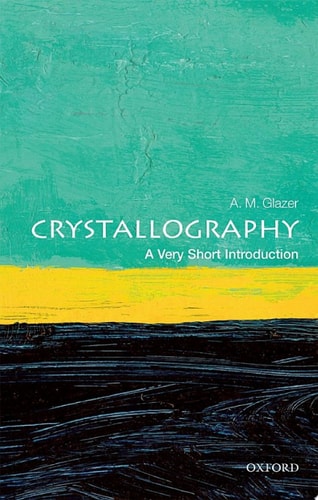
Crystallography: A Very Short Introduction
0
0
As an Amazon Associate and affiliate partner, Menrva Books earns from qualifying purchases. Learn more
Author Description
Crystals have fascinated us for centuries with their beauty and symmetry, and have often been invested with magical powers. The use of X-ray diffraction, first pioneered in 1912 by father and son William and Lawrence Bragg, enabled us to probe the structure of molecules, and heralded the scientific study of crystals, leading to an understanding of their atomic arrangements at a fundamental level. The new discipline, called X-ray crystallography, has subsequently evolved into a formidable science that underpins many other scientific areas. Starting from the determination of the structures of very simple crystals, such as that of common salt, today it has become almost routine to determine the positions of tens of thousands of atoms in a crystal. In this Very Short Introduction Mike Glazer shows how the discoveries in crystallography have been applied to the creation of new and important materials, to drugs and pharmaceuticals and to our understanding of genetics, cell biology, proteins, and viruses. Tracing the history of crystallography, he analyses astonishing developments in new sources of X-rays, as well as of neutrons, and in electron microscopy, and considers the impact they have on the study of crystals today. About the series: The Very Short Introductions series from Oxford University Press contains hundreds of titles in almost every subject area. These pocket-sized books are the perfect way to get ahead in a new subject quickly. Our expert authors combine facts, analysis, perspective, new ideas, and enthusiasm to make interesting and challenging topics highly readable.
Menrva's Summary
THE THESIS
How does the scientific study of atomic arrangements within crystals enable modern advancements in medicine, biology, and materials science? Author A. M. Glazer, a specialist in crystallography, utilizes the historical development of X-ray diffraction to explain the fundamental principles of atomic structure. The text argues that crystallography has evolved from a niche study of symmetry into a foundational methodology that supports contemporary research in genetics, pharmaceuticals, and structural biology.
THE SCOPE MAP
What You Will Find
- Historical overview of X-ray diffraction starting from the work of the Braggs in 1912
- Technical explanations of atomic arrangement and crystal symmetry
- Applications of crystallography in drug development, protein analysis, and virus research
- Analysis of modern instrumentation including neutron sources and electron microscopy
Scope Limits
- Does not provide a comprehensive laboratory manual for experimental crystallography
- Does not cover advanced mathematical derivations of diffraction patterns
THE AUTHORITY PERSPECTIVE
Experts and readers recognize this text as a highly accessible entry point for students and laypeople interested in the physical sciences. The prose maintains a balance between technical accuracy and readability, making it a standard introductory resource for those seeking to understand the impact of crystallography on modern scientific discovery.
Page Count:
144
Publication Date:
2016-01-01
Publisher:
Oxford University Press
ISBN-10:
0191027111
ISBN-13:
9780191027116
Science
Non-Fiction
Materials Science
Chemistry
Physics