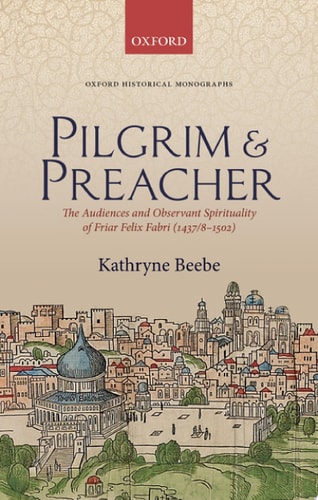
Pilgrim & Preacher: The Audiences and Observant Spirituality of Friar Felix Fabri (1437/8-1502)
0
0
As an Amazon Associate and affiliate partner, Menrva Books earns from qualifying purchases. Learn more
Author Description
Pilgrim and Preacher seeks to understand the numerous pilgrimage writings of the Dominican Felix Fabri (1437/8-1502), not only as rich descriptions of the Holy Land, Egypt, and Palestine, but also as sources for the religious attitudes and social assumptions that went into their creation. Fabri, an Observant reformer and talented preacher, as well as a two-time Holy Land pilgrim, adapted his pilgrimage experiences for four different audiences. He produced the rhymed Swabian-German Pilgerbüchlein for those who sponsored his first voyage; the encyclopaedic Latin Evagatorium for his Dominican brethren; the vernacular Pilgerbuch for the noble patrons of his second voyage and their households; and finally, the vernacular Sionpilger-an 'imagined' or 'virtual' pilgrimage - for the nuns in his care, who were unable to make the real journey themselves. This study asks fundamental questions about the readership for such works, and then builds upon an analysis of Fabri's audiences to reassess the nature of piety, and the place both pilgrimage literature and Observant reform had in it, in late-medieval Germany. Pilgrim and Preacher is a study of reception, yet one that departs from traditional approaches to pilgrimage literature, which see pilgrimage writing merely as a body of texts to be classified according to genre or mined for colourful details about the Jerusalem journey. This work combines the insights of both literary theory and historical studies with an original, empirical contribution based on an analysis of the manuscripts and printed history of Fabri's writings, setting them in their historical and cultural contexts. Such an analysis allows us to understand better the working of the religious imagination amongst urban elites and women religious in the late middle ages. By charting the influences of the Observance Movement within the Dominican, Fabri's writings were intended for both his young novices (to make them more effective preachers) and for the religious wom
Menrva's Summary
THE THESIS
How did the specific intended audiences of Dominican friar Felix Fabri influence the content, structure, and theological focus of his late-medieval pilgrimage accounts? Author Kathryne Beebe, a specialist in medieval religious history, examines the surviving manuscripts and printed editions of Fabri's works to argue that his writing was not a static record of travel, but a dynamic tool for religious instruction tailored to diverse groups. By analyzing the distinct versions of his accounts—ranging from Latin encyclopedias for brethren to vernacular guides for nuns—Beebe demonstrates how Fabri utilized the Observant reform movement to shape the piety of his readers.
THE SCOPE MAP
What You Will Find
- Analysis of four distinct pilgrimage texts: the Pilgerbüchlein, Evagatorium, Pilgerbuch, and Sionpilger.
- Examination of the Observant reform movement within the Dominican order.
- Investigation into the religious imagination of late-medieval urban elites and cloistered women.
Scope Limits
- The study focuses primarily on the reception and adaptation of Fabri's specific texts rather than a comprehensive biography of his entire life.
- The analysis is limited to the cultural and religious context of late-medieval Germany.
THE AUTHORITY PERSPECTIVE
Scholars recognize this work as a significant contribution to the study of medieval reception theory and the intersection of travel literature with religious reform. Experts frequently highlight the book's methodological rigor in moving beyond traditional genre classification to examine the social and pedagogical functions of medieval manuscripts.
Page Count:
288
Publication Date:
2014-01-01
Publisher:
OUP Oxford
ISBN-10:
0191026514
ISBN-13:
9780191026515
Biography
History
Cultural History
Middle Eastern
Literary Criticism
Religious History
Community Tags
Other Editions(3)
Similar Books










Reader Comments
Share Your Thoughts
No comments yet. Be the first to share your thoughts!