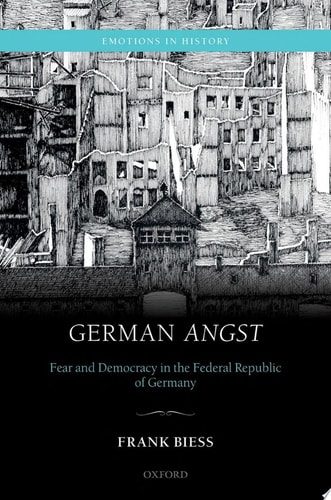
German Angst: Fear and Democracy in the Federal Republic of Germany
0
0
As an Amazon Associate and affiliate partner, Menrva Books earns from qualifying purchases. Learn more
Author Description
German Angst analyses the relationship between fear and democracy in postwar West Germany. While fear and anxiety have historically been associated with authoritarian regimes, Frank Biess demonstrates the ambivalent role of these emotions in a democratizing society: in West Germany, fear and anxiety both undermined democracy and stabilized it. By taking seriously postwar Germans' uncertainties about the future, this study challenges dominant linear and teleological narratives of postwar West German 'success', highlighting the prospective function of memories of war, National Socialism, and the Holocaust. Postwar Germans projected fears and anxieties that they derived from memories of a catastrophic past into the future. Based on case studies from the 1940s to the present, German Angst provides a new interpretive synthesis of the Federal Republic. It tells the history of the Federal Republic as a series of cyclical crises in which specific fears and anxieties emerged, served a variety of political functions, and then again abated. Drawing on recent interdisciplinary insights generated by the field of emotion studies, Biess's study transcends the dichotomy of 'reason' and 'emotion'. Fear and anxiety were not exclusively irrational and dysfunctional, but served important roles in postwar democracy. These emotions sensitized postwar Germans to the dangers of an authoritarian transformation, and they also served as emotional engines of new social movements, including the environmental and peace movements. German Angst also provides an original analysis of the emotional basis of right-wing populism in Germany today, and it explores the possibilities of a democratic politics of emotion.
Menrva's Summary
THE THESIS
This work investigates the complex, ambivalent role that fear and anxiety played in the development and stabilization of democracy in postwar West Germany. Frank Biess, a historian specializing in modern German history, utilizes an interdisciplinary approach grounded in emotion studies to challenge traditional, linear narratives of West German political success. By analyzing how memories of war and National Socialism were projected into future uncertainties, the author argues that these emotions functioned as both a destabilizing force and a necessary catalyst for democratic vigilance and social movements.
THE SCOPE MAP
What You Will Find
- Analysis of cyclical crises in the Federal Republic from the 1940s to the present.
- Examination of the emotional foundations of environmental and peace movements.
- Investigation into the emotional underpinnings of contemporary right-wing populism.
- Application of interdisciplinary emotion studies to historical political analysis.
Scope Limits
- The study focuses primarily on West German political culture rather than a comprehensive history of the entire German population.
- It does not provide a prescriptive guide for modern political policy but rather an interpretive historical synthesis.
THE AUTHORITY PERSPECTIVE
Scholars in the field of modern European history recognize this work as a sophisticated contribution to the history of emotions. Readers frequently note the academic density of the prose and the author's ability to synthesize complex psychological concepts with rigorous historical research.
Page Count:
432
Publication Date:
2020-01-01
Publisher:
OUP Oxford
ISBN-10:
0191023612
ISBN-13:
9780191023613
History
Emotion Studies
Germany history
Germany
Democracy
European History
Modern History
Community Tags
Similar Books