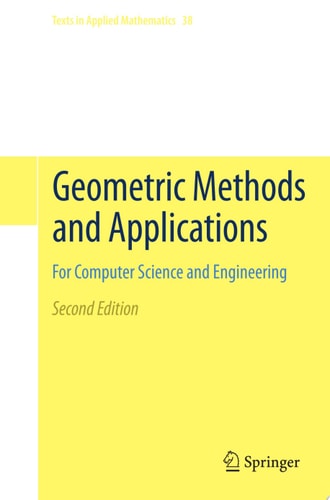
Geometric Methods and Applications
0
0
As an Amazon Associate and affiliate partner, Menrva Books earns from qualifying purchases. Learn more
Author Description
As an introduction to fundamental geometric concepts and tools needed for solving problems of a geometric nature using a computer, this book attempts to fill the gap between standard geometry books, which are primarily theoretical, and applied books on computer graphics, computer vision, or robotics, which sometimes do not cover the underlying geometric concepts in detail. Gallier offers an introduction to affine geometry, projective geometry, Euclidean geometry, basics of differential geometry and Lie groups, and a glimpse of computational geometry (convex sets, Voronoi diagrams and Delaunay triangulations) and explores many of the practical applications of geometry. Some of these applications include computer vision (camera calibration) efficient communication, error correcting codes, cryptography, motion interpolation, and robot kinematics. This comprehensive text covers most of the geometric background needed for conducting research in computer graphics, geometric modeling, computer vision, and robotics and as such will be of interest to a wide audience including computer scientists, mathematicians, and engineers.
Menrva's Summary
THE THESIS
This book introduces fundamental geometric concepts and tools essential for solving geometric problems computationally. It bridges the gap between purely theoretical geometry texts and applied computer graphics, vision, or robotics books by detailing the underlying geometric principles. The author, Jean Gallier, provides an introduction to affine, projective, and Euclidean geometry, along with basics of differential geometry, Lie groups, and computational geometry concepts like convex sets and triangulations. The text explores numerous practical applications, including camera calibration, efficient communication, error-correcting codes, cryptography, motion interpolation, and robot kinematics, making it relevant for researchers in computer graphics, geometric modeling, computer vision, and robotics.
THE SCOPE MAP
- Introduction to affine geometry
- Introduction to projective geometry
- Introduction to Euclidean geometry
- Basics of differential geometry and Lie groups
- Introduction to computational geometry (convex sets, Voronoi diagrams, Delaunay triangulations)
- Applications in computer vision (camera calibration)
- Applications in robotics (robot kinematics)
- Applications in cryptography and error-correcting codes
THE AUTHORITY PERSPECTIVE
The book is designed to serve as a comprehensive resource for individuals needing a strong geometric foundation for research in fields such as computer graphics, geometric modeling, computer vision, and robotics. Its approach aims to provide the necessary theoretical depth often missing in purely applied texts, while also demonstrating practical relevance through numerous examples. The breadth of topics covered, from fundamental geometries to advanced computational and differential concepts, suggests a text suitable for advanced students and professionals in computer science, mathematics, and engineering.
Page Count:
708
Publication Date:
2013-01-01
ISBN-10:
1461428246
ISBN-13:
9781461428244
Non-Fiction
Science
Mathematics
Computer Science
Geometry
Computer graphics
Computer Vision
Robotics