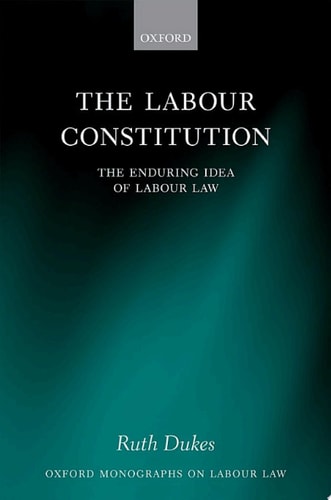
The Labour Constitution: The Enduring Idea of Labour Law
0
0
As an Amazon Associate and affiliate partner, Menrva Books earns from qualifying purchases. Learn more
Author Description
By exploring different approaches to the study of labour law, this book re-evaluates how it is conceived, analysed, and criticized in current legislation and policy. In particular, it assesses whether so-called 'old ways' of thinking about the subject, such as the idea of the labour constitution, developed by Hugo Sinzheimer in the early years of the Weimar Republic, and the principle of collective laissez-faire, elaborated by Otto Kahn-Freund in the 1950s, are in fact outdated. It asks whether, and how, these ideas could be abstracted from the political, economic, and social contexts within which they were developed so that they might still usefully be applied to the study of labour law. Dukes argues that the labour constitution can provide an 'enduring idea of labour law', and an alternative to modern arguments which favour reorienting labour law to align more closely with the functioning of labour markets. Unlike the 'law of the labour market', the labour constitution highlights the inherently political nature of labour laws and institutions, as well as their economic functions. It constructs a framework for analysing labour laws, labour markets, and institutions, to allow scholars to critique the current policy climate and, in light of the ongoing expansion of the global labour market, assess the impact of the narrowing and disappearance of spaces for democratic deliberation and democratic decision-making on workers' rights.
Menrva's Summary
THE THESIS
Can the historical concept of the labour constitution serve as a relevant framework for analyzing contemporary labour law and policy? Ruth Dukes, a scholar in legal studies, examines the evolution of labour law theory by revisiting the works of Hugo Sinzheimer and Otto Kahn-Freund. She argues that these classical ideas, when abstracted from their original historical contexts, offer a robust alternative to modern market-oriented approaches by emphasizing the political dimensions of worker rights and democratic deliberation.
THE SCOPE MAP
What You Will Find
- Analysis of the labour constitution concept from the Weimar Republic era.
- Evaluation of the principle of collective laissez-faire as defined in the 1950s.
- A comparative framework contrasting the 'labour constitution' against the 'law of the labour market'.
- Critique of current policy trends regarding global labour market expansion.
Scope Limits
- The text does not provide a comprehensive history of all global labour legislation.
- It does not offer a practical manual for day-to-day human resources or employment law compliance.
THE AUTHORITY PERSPECTIVE
Legal scholars and academics identify this work as a significant contribution to the theoretical foundations of labour law. Readers frequently note the academic density of the prose, which is intended for an audience familiar with legal theory and political philosophy.
Page Count:
272
Publication Date:
2014-01-01
Publisher:
OUP Oxford
ISBN-10:
0191038601
ISBN-13:
9780191038600
Economics
Labor laws and legislation
Labour Law
Legal Theory
Sociology
Law
Professional Career & Trade
Community Tags
Similar Books