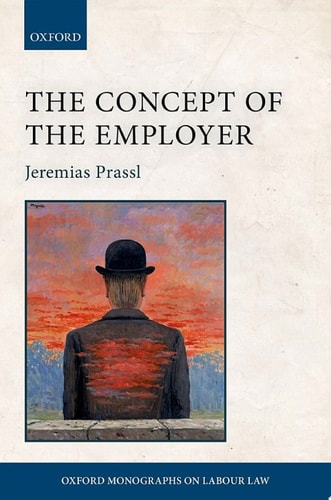
The Concept of the Employer
0
0
As an Amazon Associate and affiliate partner, Menrva Books earns from qualifying purchases. Learn more
Author Description
Employment law has increasingly struggled to adapt to complex modern work arrangements, from agency work to corporate groups. This book suggests that the reason for this failure can be found in our concept of the employer, which has become riddled with internal contradictions in its search for a unitary employer, the counterparty to a bilateral contract, through a series of multi-functional tests focussed on the exercise of a range of employer functions. As a result of this tension, full employment law coverage is restricted to a narrow scenario where a single legal entity exercises all employer functions - a paradigm far from the reality of modern labour markets characterized by a fragmentation of work, from the rise of employment agencies and service companies to corporate groups and Private Equity investors. These problems can only be addressed by a careful reconceptualization and the development of a functional concept of the employer. The book draws on existing models in English, German, and European law to develop a definition of the employer as the entity, or combination of entities, exercising functions regulated in a particular domain of employment law. Each of the two strands of the current concept is addressed in turn to demonstrate how a more openly multi-functional approach can successfully overcome the rigidities of the current notion without abandoning a coherent underlying framework. It fills a crucial gap in employment law and corporate law with its analysis of the defects in our current understanding of the employer, and in developing a new functional concept designed to overcome the problems identified.
Menrva's Summary
THE THESIS
This book investigates the failure of current employment law to address modern work arrangements by identifying the internal contradictions within the traditional, unitary concept of the employer. Jeremias Prassl, an expert in labour law, argues that the legal focus on a single entity as the counterparty to a bilateral contract is insufficient for contemporary markets. By analyzing the fragmentation of work across corporate groups and service companies, the author proposes a new, functional definition of the employer that aligns legal responsibility with the actual exercise of employer functions.
THE SCOPE MAP
What You Will Find
- Comparative analysis of English, German, and European labour law models
- A proposed functional framework for defining employer status
- Examination of corporate groups, employment agencies, and private equity structures
Scope Limits
- Does not provide a comprehensive guide to individual employment contract litigation
- Focuses primarily on the legal definition of the employer rather than broader social policy implications
THE AUTHORITY PERSPECTIVE
Legal scholars and practitioners identify this work as a significant contribution to the modernization of labour law frameworks. Readers frequently note the academic density of the prose, which is intended for an audience of legal professionals and researchers.
Page Count:
288
Publication Date:
2015-01-01
Publisher:
OUP Oxford
ISBN-10:
0191054437
ISBN-13:
9780191054433
Labor laws and legislation
Labour Law
Academic
Professional Career & Trade
Corporate Law
Employment Law
Law
Community Tags
Other Editions(4)

Similar Books












Reader Comments
Share Your Thoughts
No comments yet. Be the first to share your thoughts!