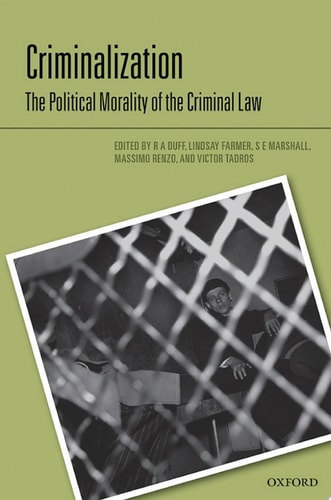
Criminalization: The Political Morality of the Criminal Law
0
0
As an Amazon Associate and affiliate partner, Menrva Books earns from qualifying purchases. Learn more
Author Description
The Criminalization series arose from an interdisciplinary investigation into criminalization, focussing on the principles that might guide decisions about what kinds of conduct should be criminalized, and the forms that criminalization should take. Developing a normative theory of criminalization, the series tackles the key questions at the heart of the issue: what principles and goals should guide legislators in deciding what to criminalize? How should criminal wrongs be classified and differentiated? How should law enforcement officials apply the law's specifications of offences? The fourth book in the series examines the political morality of the criminal law, exploring general principles and theories of criminalization. Chapters provide accounts of the criminal law in the light of ambitious theories about moral and political philosophy - republicanism and contractarianism, or reflect upon on the success of important theories of criminalization by viewing them in a novel light. Ideas that are fundamental to any complete theory of the criminal law - liberty, harm, and the effect on victims - are investigated in depth. Sociological investigation of the criminal law grounds a critical investigation into the principles of criminalization, both as a legislative matter, and with respect to criminalization practices, in contemporary and historical contexts. The volume broadens our conceptions of the theory of criminalization, and clarifies the role of the series in the development of this theory. It is essential reading for all interested in legal, political, and social theories of criminalization.
Menrva's Summary
THE THESIS
This volume investigates the normative principles that should govern the scope and application of criminal law within a democratic society. The authors, a team of legal scholars and philosophers, utilize a framework rooted in moral and political philosophy to evaluate how conduct is classified as criminal. By synthesizing republican and contractarian perspectives, the text seeks to establish a coherent theory for legislators and practitioners regarding the limits of state power and the justification of penal sanctions.
THE SCOPE MAP
What You Will Find
- Analysis of republican and contractarian political theories applied to criminal law
- Examination of core concepts including liberty, harm, and victim impact
- Historical and contemporary sociological investigations into criminalization practices
- Critical assessment of legislative decision-making processes
Scope Limits
- Does not provide a comprehensive manual for specific criminal code drafting
- Does not focus on procedural criminal law or courtroom litigation tactics
THE AUTHORITY PERSPECTIVE
Experts recognize this volume as a significant contribution to the ongoing interdisciplinary debate surrounding the moral foundations of criminalization. Readers frequently note the academic density of the prose, which requires a strong background in legal or political theory to fully synthesize the arguments presented.
Page Count:
336
Publication Date:
2014-01-01
Publisher:
OUP Oxford
ISBN-10:
0191043362
ISBN-13:
9780191043369
Sociology
Law
Criminology
Ethics
Professional Career & Trade
Legal Theory
Political Philosophy
Community Tags
Similar Books