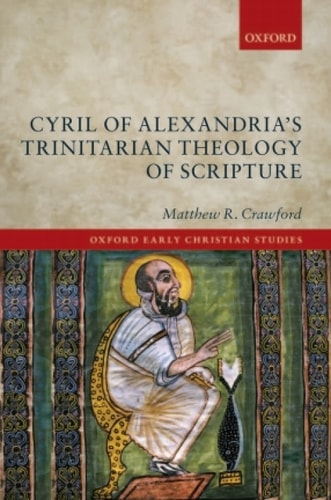
Cyril of Alexandria's Trinitarian Theology of Scripture
0
0
As an Amazon Associate and affiliate partner, Menrva Books earns from qualifying purchases. Learn more
Author Description
More exegetical literature survives from the hand of Cyril of Alexandria than nearly any other Greek patristic author, yet this sizable body of work has scarcely received the degree of attention it deserves. In this work, Matthew R. Crawford reconstructs the intellectual context that gave rise to this literary output and highlights Cyril's Trinitarian theology, received as an inheritance from the fourth century, as the most important defining factor. Cyril's appropriation of pro-Nicene Trinitarianism is evident in both of his theology of revelation and his theology of exegesis, the two foci that comprise his doctrine of Scripture. Revelation, in his understanding, proceeds from the Father, through the Son, and in the Spirit, following the order of Trinitarian relations. Moreover, this pattern applies to the inspiration of Scripture as well, insofar as inspiration occurs when the Son indwells human authors by the Spirit and speaks the words of the Father. Although Cyril's interpretation of revelation may consequently be called 'Trinitarian', it is also resolutely Christological, since the divine and incarnate Son functions as the central content and mediator of all divine unveiling. Corresponding to this divine movement towards humanity in revelation is humanity's appropriation of divine life according to the reverse pattern--in the Spirit, through the Son, unto the Father. Applied to exegesis, this Trinitarian pattern implies that the Spirit directs the reader of Scripture to a Christological interpretation of the text, through which the believer beholds the incarnate Son, the exemplar of virtue and the perfect image of the Father, and accordingly advances in both virtue and knowledge. This process continues until the final eschatological vision when the types and riddles of Scripture will be done away with in light of the overwhelming clarity of the Christologically-mediated Trinitarian vision.
Menrva's Summary
THE THESIS
This work investigates how Cyril of Alexandria’s Trinitarian theology serves as the foundational framework for his extensive body of exegetical literature. Matthew R. Crawford, an expert in early Christian studies, utilizes a rigorous analysis of Cyril's writings to demonstrate that his doctrine of Scripture is inseparable from his pro-Nicene Trinitarian commitments. By mapping the movement of revelation from the Father, through the Son, and in the Spirit, Crawford argues that Cyril’s approach to biblical interpretation is both inherently Trinitarian and resolutely Christological.
THE SCOPE MAP
What You Will Find
- Analysis of Cyril of Alexandria’s theology of revelation and exegesis
- Examination of the Trinitarian pattern of inspiration in human authors
- Discussion of the Christological mediation of divine unveiling
- Exploration of the reader's role in the process of virtue and knowledge acquisition
Scope Limits
- The study focuses primarily on Cyril's Trinitarian framework rather than a comprehensive biography or a general history of the period
- It does not provide a verse-by-verse commentary on the entirety of Cyril's biblical corpus
THE AUTHORITY PERSPECTIVE
Scholars recognize this text as a significant contribution to the study of patristic hermeneutics and the intellectual history of the fifth century. Readers frequently note the academic density of the prose and the precision with which Crawford reconstructs the theological context of Cyril's work.
Page Count:
304
Publication Date:
2014-01-01
Publisher:
OUP Oxford
ISBN-10:
0191034134
ISBN-13:
9780191034138
Religion
Theology
Patristics
Academic
Trinity
Christian History
Community Tags
Other Editions(3)

Similar Books

Reader Comments
Share Your Thoughts
No comments yet. Be the first to share your thoughts!