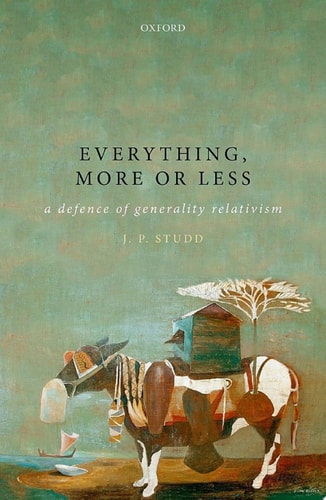
Everything, More or Less: A Defence of Generality Relativism
0
0
As an Amazon Associate and affiliate partner, Menrva Books earns from qualifying purchases. Learn more
Author Description
Almost no systematic theorizing is generality-free. Scientists test general hypotheses; set theorists prove theorems about every set; metaphysicians espouse theses about all things regardless of their kind. But how general can we be and do we ever succeed in theorizing about absolutely everything? Not according to generality relativism. In its most promising form, this kind of relativism maintains that what 'everything' and other quantifiers encompass is always open to expansion: no matter how broadly we may generalize, a more inclusive 'everything' is always available. The importance of the issue comes out, in part, in relation to the foundations of mathematics. Generality relativism opens the way to avoid Russell's paradox without imposing ad hoc limitations on which pluralities of items may be encoded as a set. On the other hand, generality relativism faces numerous challenges: What are we to make of seemingly absolutely general theories? What prevents our achieving absolute generality simply by using 'everything' unrestrictedly? How are we to characterize relativism without making use of exactly the kind of generality this view foreswears? This book offers a sustained defence of generality relativism that seeks to answer these challenges. Along the way, the contemporary absolute generality debate is traced through diverse issues in metaphysics, logic, and the philosophy of language; some of the key works that lie behind the debate are reassessed; an accessible introduction is given to the relevant mathematics; and a relativist-friendly motivation for Zermelo-Fraenkel set theory is developed.
Menrva's Summary
THE THESIS
This book investigates the viability of generality relativism, specifically questioning whether human theorizing can ever achieve absolute generality or if all quantifiers are inherently subject to expansion. J. P. Studd, a scholar in logic and philosophy, constructs a rigorous defense of the relativist position by examining the limitations of unrestricted quantification. The work synthesizes historical debates in metaphysics and logic to propose a framework that addresses the paradoxes of set theory while maintaining a coherent philosophical stance.
THE SCOPE MAP
What You Will Find
- An analysis of the absolute generality debate within metaphysics and logic.
- A technical defense of generality relativism as a solution to Russell's paradox.
- An introduction to the mathematical foundations relevant to set theory.
- A re-evaluation of key historical texts concerning quantification.
Scope Limits
- The text does not provide a general introduction to philosophy, assuming a baseline familiarity with formal logic.
- It does not attempt to resolve all problems in set theory, focusing specifically on the implications of generality relativism.
THE AUTHORITY PERSPECTIVE
Experts in the field of analytic philosophy recognize this monograph as a significant contribution to the ongoing discourse on quantification and set-theoretic foundations. Readers frequently note the academic density of the prose, which is intended for advanced students and researchers in logic and philosophy.
Page Count:
293
Publication Date:
2019-01-01
Publisher:
OUP Oxford
ISBN-10:
0191030368
ISBN-13:
9780191030369
Philosophy
Mathematics
Academic
Logic
Logic & Critical Reasoning
Philosophy of
Relativity
Metaphysics
Community Tags
Similar Books