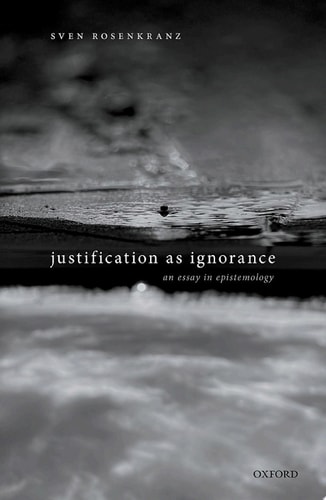
Justification as Ignorance: An Essay in Epistemology
0
0
As an Amazon Associate and affiliate partner, Menrva Books earns from qualifying purchases. Learn more
Author Description
Justification as Ignorance offers an original account of epistemic justification as both non-factive and luminous, vindicating core internalist intuitions without construing justification as an internal condition knowable by reflection alone. Sven Rosenkranz conceives of justification, in its doxastic and propositional varieties, as a kind of epistemic possibility of knowing and of being in a position to know. His account contrasts with recent alternative views that characterize justification in terms of the metaphysical possibility of knowing. Instead, he develops a suitable non-normal multi-modal epistemic logic for knowledge and being in a position to know that respects the finding that these notions create hyperintensional contexts. He also defends his conception of justification against well-known anti-luminosity arguments, shows that the account allows for fruitful applications and principled solutions to the lottery and preface paradoxes, and provides a metaphysics of justification and its varying degrees of strength that is compatible with core assumptions of the knowledge-first approach and disjunctivist conceptions of mental states.
Menrva's Summary
THE THESIS
This work investigates the nature of epistemic justification by proposing that it should be understood as a form of ignorance—specifically, the epistemic possibility of knowing or being in a position to know. Sven Rosenkranz, a philosopher specializing in epistemology and logic, utilizes a formal framework of non-normal multi-modal epistemic logic to bridge the gap between internalist intuitions and the knowledge-first approach. By defining justification through the lens of epistemic possibility rather than metaphysical possibility, he constructs a model that addresses hyperintensional contexts and provides a robust alternative to traditional internalist theories.
THE SCOPE MAP
What You Will Find
- A non-normal multi-modal epistemic logic framework for knowledge and epistemic positioning.
- A defense of the luminosity of justification against standard anti-luminosity arguments.
- Formal applications to the lottery paradox and the preface paradox.
- A metaphysics of justification that integrates with disjunctivist mental state theories.
Scope Limits
- The text does not provide an exhaustive historical survey of all internalist theories.
- It does not address non-epistemic forms of justification found in ethics or practical reasoning.
THE AUTHORITY PERSPECTIVE
Experts in formal epistemology identify this text as a rigorous contribution to the knowledge-first literature, noting its technical complexity and reliance on modal logic. Readers frequently highlight the density of the prose, which is intended for advanced students and professional philosophers working within analytic epistemology.
Page Count:
300
Publication Date:
2021-01-01
Publisher:
OUP Oxford
ISBN-10:
0192635085
ISBN-13:
9780192635082
Philosophy
Epistemology
Logic
Metaphysics
Academic
Community Tags
Similar Books