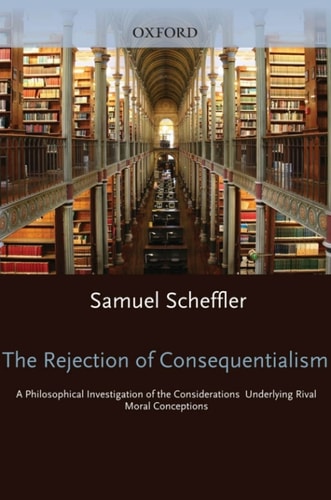
The Rejection of Consequentialism: A Philosophical Investigation of the Considerations Underlying Rival Moral Conceptions
0
0
As an Amazon Associate and affiliate partner, Menrva Books earns from qualifying purchases. Learn more
Author Description
In contemporary philosophy, substantive moral theories are typically classified as either consequentialist or deontological. Standard consequentialist theories insist, roughly, that agents must always act so as to produce the best available outcomes overall. Standard deontological theories, by contrast, maintain that there are some circumstances where one is permitted but not required to produce the best overall results, and still other circumstances in which one is positively forbidden to do so. Classical utilitarianism is the most familiar consequentialist view, but it is widely regarded as an inadequate account of morality. Although Professor Scheffler agrees with this assessment, he also believes that consequentialism seems initially plausible, and that there is a persistent air of paradox surrounding typical deontological views. In this book, therefore, he undertakes to reconsider the rejection of consequentialism. He argues that it is possible to provide a rationale for the view that agents need not always produce the best possible overall outcomes, and this motivates one departure from consequentialism; but he shows that it is surprisingly difficult to provide a satisfactory rationale for the view that there are times when agents must not produce the best possible overall outcomes. He goes on to argue for a hitherto neglected type of moral conception, according to which agents are always permitted, but not always required, to produce the best outcomes.
Menrva's Summary
THE THESIS
This work investigates the philosophical tension between consequentialist and deontological moral frameworks to determine if a more coherent alternative exists. Samuel Scheffler, a prominent philosopher, examines the intuitive appeal of consequentialism against the perceived paradoxes of deontological constraints. He utilizes analytical argumentation to evaluate why agents might be permitted to deviate from maximizing outcomes while questioning the logical necessity of absolute prohibitions against producing the best results.
THE SCOPE MAP
What You Will Find
- A critical analysis of classical utilitarianism and its perceived inadequacies.
- A formal examination of agent-centered prerogatives in moral decision-making.
- A proposed hybrid moral conception that permits but does not mandate outcome maximization.
Scope Limits
- The text does not provide a comprehensive history of all ethical schools of thought.
- It does not address applied ethics or specific policy-making scenarios.
THE AUTHORITY PERSPECTIVE
Scholars frequently cite this text as a significant contribution to the debate regarding agent-centered constraints and the structure of moral requirements. Readers often note the rigorous analytical density of the prose, which is intended for an audience familiar with contemporary moral philosophy.
Page Count:
207
Publication Date:
1994-01-01
Publisher:
Clarendon Press
ISBN-10:
0191040169
ISBN-13:
9780191040160
Non-Fiction
Philosophy
Ethics
Moral Philosophy
Community Tags
Other Editions(3)
Similar Books







Reader Comments
Share Your Thoughts
No comments yet. Be the first to share your thoughts!