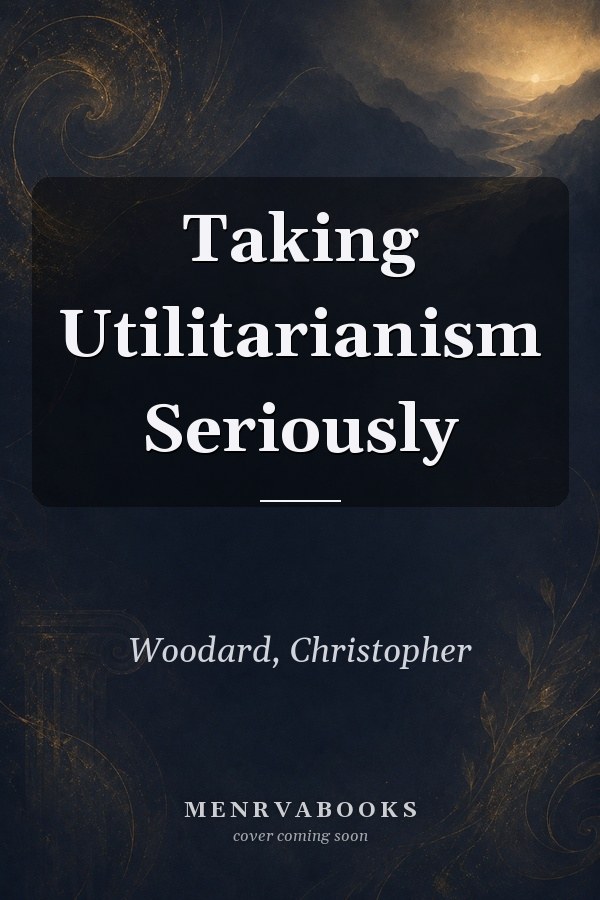
Taking Utilitarianism Seriously
0
0
As an Amazon Associate and affiliate partner, Menrva Books earns from qualifying purchases. Learn more
Author Description
Utilitarianism is the idea that ethics is ultimately about what makes people's lives go better. While utilitarian ideas remain highly influential in politics and culture, they are subject to many well-developed philosophical criticisms, such as the claim that utilitarianism requires too much of us and the view that it does not respect individuals' rights. The theory is widely thought by philosophers to be the least plausible form of consequentialism, hampered by its excessive simplicity. In Taking Utilitarianism Seriously, Christopher Woodard argues that it is not defeated by the standard objections. He presents a new and rich version of utilitarianism that can answer all six commons objections plausibly and, in doing so, launches a state-of-the-art defence of the utilitarian tradition, which has greater resources than its critics have often assumed. Far from being excessively simple, utilitarianism is able to account for much of the complexity and nuance of everyday ethical thought. And rather than being quickly dismissed, utilitarian approaches to moral and political philosophy are due for renewed development and discussion.
Menrva's Summary
THE THESIS
Can utilitarianism be defended against the standard philosophical objections that characterize it as overly simplistic or dismissive of individual rights? Christopher Woodard, a scholar of moral philosophy, examines the historical and contemporary critiques of utilitarian theory. He argues that the tradition possesses significant, underutilized resources that allow it to address common objections while maintaining a nuanced account of ethical life.
THE SCOPE MAP
What You Will Find
- A systematic rebuttal of six common philosophical objections to utilitarianism.
- A reformulated version of utilitarian theory designed to handle complex ethical scenarios.
- An analysis of the relationship between utilitarianism and everyday moral intuition.
Scope Limits
- The text does not provide a comprehensive history of consequentialism.
- It does not focus on applied policy implementation but rather on the theoretical defense of the framework.
THE AUTHORITY PERSPECTIVE
Scholars and students of moral philosophy recognize this work as a significant contribution to the ongoing debate regarding the viability of utilitarianism. Readers frequently note the academic density of the prose, which is intended for those already familiar with the core tenets of consequentialist thought.
Page Count:
258
Publication Date:
2019-01-01
Publisher:
OUP Oxford
ISBN-10:
0191047007
ISBN-13:
9780191047008
Philosophy
Utilitarianism
Political Philosophy
Moral Philosophy
Ethics
Community Tags
Other Editions(3)

Similar Books