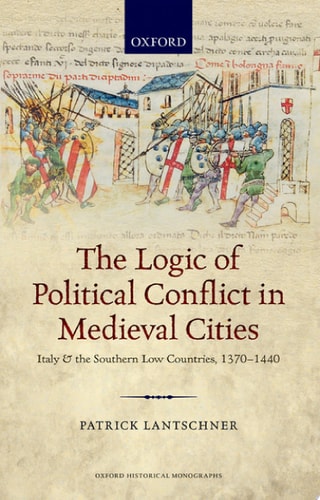
The Logic of Political Conflict in Medieval Cities: Italy and the Southern Low Countries, 1370-1440
0
0
As an Amazon Associate and affiliate partner, Menrva Books earns from qualifying purchases. Learn more
Author Description
This volume traces the logic of urban political conflict in late medieval Europe's most heavily urbanized regions, Italy and the Southern Low Countries. The fourteenth and fifteenth centuries are often associated with the increasing consolidation of states, but at the same time they also saw high levels of political conflict and revolt in cities that themselves were a lasting heritage of this period. In often radically different ways, conflict constituted a crucial part of political life in the six cities studied for this book: Bologna, Florence, and Verona, as well as Liège, Lille, and Tournai. The Logic of Political Conflict in Medieval Cities argues that such conflicts, rather than subverting ordinary political life, were essential features of the political systems that developed in cities. Conflicts were embedded in a polycentric political order characterized by multiple political units and bases of organization, ranging from guilds to external agencies. In this multi-faceted and shifting context, late medieval city dwellers developed particular strategies of legitimating conflict, diverse modes of behaviour, and various forms of association through which conflict could be addressed. At the same time, different configurations of these political units gave rise to specific systems of conflict which varied from city to city. Across all these cities, conflict lay at the basis of a distinct form of political organization-and represents the nodal point around which this political and social history of cities is written.
Menrva's Summary
THE THESIS
This volume investigates the core question of how urban political conflict functioned as an essential, rather than disruptive, component of political systems in late medieval European cities. Patrick Lantschner, a specialist in medieval urban history, utilizes a comparative framework to analyze the political structures of six major cities in Italy and the Southern Low Countries. He argues that conflict was not a sign of systemic failure but a foundational element of a polycentric political order where guilds, factions, and external agencies interacted to shape governance.
THE SCOPE MAP
What You Will Find
- Comparative analysis of political systems in Bologna, Florence, Verona, Liège, Lille, and Tournai.
- Examination of the period between 1370 and 1440.
- Analysis of strategies for legitimating conflict and modes of political association.
Scope Limits
- The study focuses specifically on urban centers and does not provide a comprehensive history of rural or state-level political developments.
- The analysis is restricted to the specific geographic regions of Italy and the Southern Low Countries.
THE AUTHORITY PERSPECTIVE
Historians and scholars of the late medieval period frequently cite this work for its rigorous comparative methodology and its challenge to traditional narratives regarding state consolidation. Readers often note the academic density of the prose, which is intended for an audience familiar with medieval political theory and urban history.
Page Count:
304
Publication Date:
2015-01-01
Publisher:
OUP Oxford
ISBN-10:
0191053848
ISBN-13:
9780191053849
History
European History
Urban History
Europe
Violence
Community Tags
Similar Books