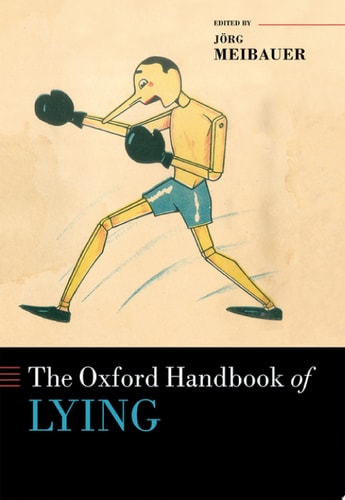
The Oxford Handbook of Lying
0
0
As an Amazon Associate and affiliate partner, Menrva Books earns from qualifying purchases. Learn more
Author Description
This handbook brings together past and current research on all aspects of lying and deception, with chapters contributed by leading international experts in the field. We are confronted daily with cases of lying, deception, bullshitting, and 'fake news', making it imperative to understand how lying works, how it can be defined, and whether it can be detected. A further important issue is whether lying should always be considered a bad thing or if, in some cases, it is simply a useful instrument of human cognition. This volume is the first to offer a comprehensive and up-to-date exploration of these and other issues from the combined perspectives of linguistics, philosophy, and psychology. Chapters offer precise definitions of lying and its subtypes, and outline the range of fields in which lying and deception play a role, from empirical lie detection and the acquisition of lying to its role in fiction, metaphor, and humour. They also describe the tools and approaches that are used by scholars researching lying and deception, such as questionnaire studies, EEG, neuroimaging, and the polygraph. The volume will be an essential reference for students and researchers in a range of fields who are looking to deepen their understanding of all aspects of lying and deception, and will contribute to establishing the vibrant new field of interdisciplinary lying research.
Menrva's Summary
THE THESIS
This handbook investigates the multifaceted nature of lying and deception by synthesizing research across linguistics, philosophy, and psychology to define its mechanisms and ethical implications. Editor Jörg Meibauer compiles contributions from international experts to address how lying functions in human cognition, social interaction, and contemporary media environments. The volume provides a rigorous framework for analyzing deception, moving beyond simple definitions to explore its role in humor, metaphor, and empirical detection methods.
THE SCOPE MAP
What You Will Find
- Definitions of lying and its various subtypes
- Methodologies including EEG, neuroimaging, and questionnaire studies
- Analysis of deception in fiction, metaphor, and humor
- Exploration of the ethics of lying as a cognitive instrument
Scope Limits
- Does not provide a singular, universal moral verdict on the act of lying
- Does not focus on a single academic discipline, but rather an interdisciplinary overview
THE AUTHORITY PERSPECTIVE
Experts recognize this volume as a foundational reference for interdisciplinary studies on deception. Readers frequently note the academic density of the prose, which is tailored specifically for researchers and students in the humanities and social sciences.
Page Count:
684
Publication Date:
2018-01-01
Publisher:
OUP Oxford
ISBN-10:
0191056219
ISBN-13:
9780191056215
Psychology
Philosophy
Reference
English
Social Science
Linguistics
Academic
English & College Success