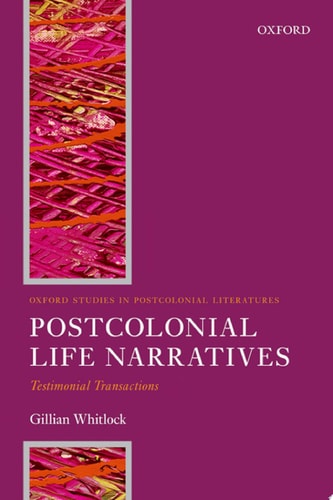
Postcolonial Life Narratives: Testimonial Transactions
0
0
As an Amazon Associate and affiliate partner, Menrva Books earns from qualifying purchases. Learn more
Author Description
The Oxford Studies in Postcolonial Literatures series offers stimulating and accessible introductions to definitive topics and key genres and regions within the rapidly diversifying field of postcolonial literary studies in English. Postcolonial Life Narrative draws together two dynamic fields of contemporary literature and criticism, postcolonialism and life narrative, to create a new assemblage: postcolonial life narrative. Focusing in particular on testimonial narrative, from slave narrative in the late eighteenth century to contemporary Anglophone life narrative from Africa, Australia, the Caribbean, Palestine, North America, and India, this study follows texts on the move through adaptation, appropriation, and remediation. For postcolonial subjects life narrative offers extraordinary opportunities to present accounts of social injustice and oppression, of violence and social suffering. Testimonial narrative can reach across cultures to produce intimate attachments between those who testify and those who bear witness to legacies of apartheid, slavery, rape warfare, genocide, and dispossession. Thresholds of testimony are subject to change and for some, for example refugees and asylum seekers, opportunities to engage a witnessing public and inspire campaigns for social justice on their behalf are curtailed--these are the 'ends of testimony'. The production, circulation, and reception of testimonial life narrative connects directly to the most fundamental questions of who counts as human, what rights follow from this, and what makes for grievable life. Postcolonial life narrative is a dynamic field of literature and criticism, and this book presents a series of proximate readings that outline its distinctive imaginative geographies.
Menrva's Summary
THE THESIS
This book investigates how testimonial life narratives function as a bridge between postcolonial subjects and global audiences to address systemic injustice and human rights. Gillian Whitlock, a scholar in postcolonial literature, synthesizes historical and contemporary texts to argue that life narratives serve as a critical mechanism for defining human rights and grievability. By examining the movement of these texts across borders, she establishes a framework for understanding how personal accounts of suffering are adapted and received within diverse political contexts.
THE SCOPE MAP
What You Will Find
- Analysis of testimonial narratives ranging from eighteenth-century slave accounts to modern Anglophone literature.
- Examination of geographical regions including Africa, Australia, the Caribbean, Palestine, North America, and India.
- A theoretical framework for 'testimonial transactions' and the remediation of life narratives.
Scope Limits
- The study does not provide an exhaustive catalog of every postcolonial life narrative ever published.
- It focuses primarily on testimonial and political dimensions rather than purely aesthetic or formalist literary analysis.
THE AUTHORITY PERSPECTIVE
Scholars recognize this work as a significant contribution to the intersection of postcolonial theory and life writing studies. Experts frequently note the clarity with which Whitlock navigates complex ethical questions regarding the circulation and reception of traumatic narratives.
Page Count:
224
Publication Date:
2015-01-01
Publisher:
OUP Oxford
ISBN-10:
0191054232
ISBN-13:
9780191054235
Human rights
English
English literature
English & College Success
Literary Criticism
Biography Autobiography
Community Tags
Similar Books