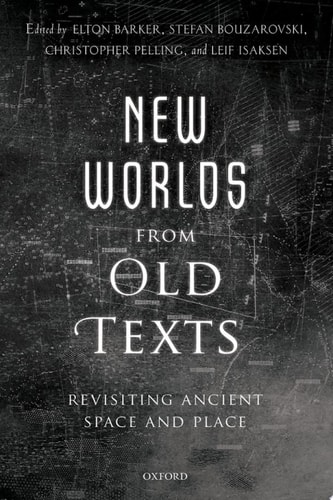
New Worlds From Old Texts
0
0
As an Amazon Associate and affiliate partner, Menrva Books earns from qualifying purchases. Learn more
Author Description
Maps Dominate The Modern Sense Of Place And Geography. Yet, So Far As We Can Tell, Maps Were Rare In The Greco-roman World And, When Mentioned In Sources, Are Mistrusted And Criticized. Today, Technological Advances Have Brought To The Fore An Entirely New Set Of Methods For Representing And Interacting With Space. In Contrast To Traditional 'topographic' Perspectives, The Territorial Extent Of Economic And Political Realms Is Increasingly Conceived Though A 'topological' Lens, In Which The Nature And Frequency Of Links Among Different Sites Matter More Than The Physical Distances Between Them. New Worlds From Old Texts Focuses On The Ancient Greek Experience Of Space, Conceived Of In Terms Of Both Its Literature And Material Culture Remains, And Uses This To Reflect On Modern Thinking. Comprising Twelve Chapters Written By A Highly Interdisciplinary Range Of Contributors, This Edited Collection Explores The Rich Array Of Representational Devices Employed By Ancient Authors, Whose Narrative Depictions Of Spatial Relations Defy The Logic Of Images And Surfaces That Dominates Contemporary Cartographic Thought. The Volume Focuses On Herodotus' Histories-a Text That Is Increasingly Cited By Classicists As An Example Of How Ancient Perceptions Of Space May Have Been Rather Different To The Modern Cartographic View-but Also Considers Perceptions Of Space Through The Lens Of Other Authors, Genres, Cultural Contexts, And Disciplines. In Doing So, It Reveals How A Study Of The Ancient World Can Be Reinvigorated By, And In Turn Help To Shape, Modern Technological Innovation And Methods.
Menrva's Summary
THE THESIS
How can the study of ancient Greek spatial representation inform and challenge modern cartographic and topological understandings of geography? This edited collection, curated by scholars Christopher Pelling, Elton T. E. Barker, Leif Isaksen, and Stefan Bouzarovski, synthesizes classical philology with contemporary digital humanities. The authors argue that ancient texts, particularly those of Herodotus, utilize narrative devices to construct space that differ significantly from modern visual mapping, offering a framework to reconsider how we conceptualize political and economic connectivity.
THE SCOPE MAP
What You Will Find
- Analysis of spatial representation in Herodotus' Histories and other classical texts.
- Comparison between traditional topographic mapping and modern topological network theory.
- Interdisciplinary methodologies combining literary analysis, material culture, and digital spatial modeling.
Scope Limits
- The volume does not provide a comprehensive history of ancient cartography.
- It does not offer a technical manual for specific GIS software or digital mapping tools.
THE AUTHORITY PERSPECTIVE
Scholars and classicists recognize this work as a significant contribution to the intersection of ancient literature and spatial theory. Readers frequently note the academic density of the prose, which serves as a bridge between traditional humanities and modern technological methodologies.
Page Count:
456
Publication Date:
2015-01-01
Publisher:
Oxford University Press
ISBN-10:
019105786X
ISBN-13:
9780191057861
History
Ancient Greece
Geography
Literary Criticism
Community Tags
Similar Books