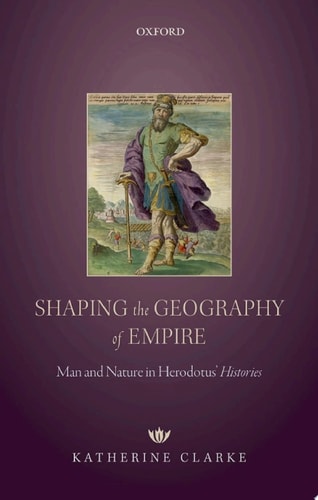
Shaping the Geography of Empire: Man and Nature in Herodotus' Histories
0
0
As an Amazon Associate and affiliate partner, Menrva Books earns from qualifying purchases. Learn more
Author Description
This volume explores the spatial framework of Herodotus' Histories, the Greek historian's account of Persian imperialism in the sixth and fifth century BC and its culmination in a series of grand expeditions against Greece itself. Focusing on his presentation of the natural world through careful geographical descriptions, ranging from continents and river and mountain networks on a vast scale down to the local settings for individual episodes, it also examines how these landscapes are charged with greater depth and resonance through Herodotus' use of mythological associations and spatial parallels. Man's interaction with, and alteration of, the physical world of the Histories adds another critical dimension to the meaning given to space in Herodotus' work, as his subjects' own agency serves to transform their geography from a neutral backdrop into a resonant landscape with its own role to play in the narrative, in turn reinforcing the placing of the protagonists along a spectrum of positive or negative characterizations. The Persian imperial bid may thus be seen as a war on nature, no less than on their intended subjects: however, as Herodotus reflects, Greece itself is waiting in the wings with the potential to be no less abusive an imperial power. Although the multi-vocal nature of the narrative complicates whether we can identify a 'Herodotean' world at all, still less one in which moral judgements are consistently cast, the fluid and complex web of spatial relationships revealed in discussion nevertheless allows focalization to be brought productively into play, demonstrating how the world of the Histories may be viewed from multiple perspectives. What emerges from the multiple worlds and world-views that Herodotus creates in his narrative is the mutability of fortune that allows successive imperial powers to dominate: as the exercise of political power is manifested both metaphorically and literally through control over the natural world, the map of imperial ge
Menrva's Summary
THE THESIS
This volume investigates how Herodotus utilizes geographical descriptions and the interaction between human agency and the natural world to construct a spatial framework for his account of Persian imperialism. Katherine M. Clarke, a scholar of ancient history, analyzes the Histories to demonstrate how physical landscapes function as more than neutral backdrops, serving instead as active elements that reflect the moral character and imperial ambitions of the historical figures depicted. By examining the intersection of geography, mythology, and political power, the author argues that the control of nature serves as a metaphor for the exercise of imperial dominance.
THE SCOPE MAP
What You Will Find
- Analysis of the spatial framework within the Histories of Herodotus
- Examination of the relationship between human agency and physical geography
- Exploration of mythological associations and spatial parallels in ancient narratives
- Discussion of the mutability of fortune and imperial power dynamics
Scope Limits
- The study focuses specifically on the spatial and geographical dimensions of Herodotus' work rather than a comprehensive historical biography or military analysis of the Persian Wars.
THE AUTHORITY PERSPECTIVE
Scholars and classicists recognize this work as a significant contribution to the study of Herodotean historiography and the spatial turn in ancient history. Readers frequently note the academic density of the prose, which provides a rigorous examination of how geography informs the narrative structure of the Histories.
Page Count:
368
Publication Date:
2018-01-01
Publisher:
OUP Oxford
ISBN-10:
0192552384
ISBN-13:
9780192552389
History
Ancient Greece
Geography Ancient
Historiography
Geography
Historical geography
Herodotus
Ancient History
Community Tags
Other Editions(2)
Similar Books



Reader Comments
Share Your Thoughts
No comments yet. Be the first to share your thoughts!