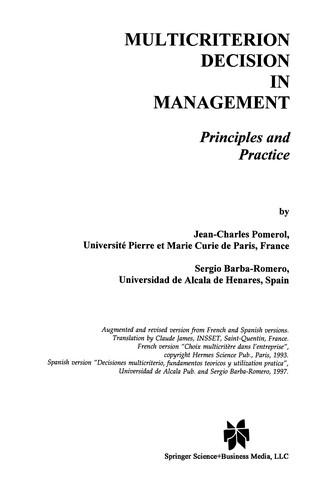
Multicriterion Decision in Management
0
0
As an Amazon Associate and affiliate partner, Menrva Books earns from qualifying purchases. Learn more
Author Description
Multicriterion Decision in Management: Principles and Practice is the first multicriterion analysis book devoted exclusively to discrete multicriterion decision making. Typically, multicriterion analysis is used in two distinct frameworks: Firstly, there is multiple criteria linear programming, which is an extension of the results of linear programming and its associated algorithms. Secondly, there is discrete multicriterion decision making, which is concerned with choices among a finite number of possible alternatives such as projects, investments, decisions, etc. This is the focus of this book. The book concentrates on the basic principles in the domain of discrete multicriterion analysis, and examines each of these principles in terms of their properties and their implications. In multicriterion decision analysis, any optimum in the strict sense of the term does not exist. Rather, multicriterion decision making utilizes tools, methods, and thinking to examine several solutions, each having their advantages and disadvantages, depending on one's point of view. Actually, various methods exist for reaching a good choice in a multicriterion setting and even a complete ranking of the alternatives. The book describes and compares these methods, so-called `aggregation methods', with their advantages and their shortcomings. Clearly, organizations are becoming more complex, and it is becoming harder and harder to disregard complexity of points of view, motivations, and objectives. The day of the single objective (profit, social environment, etc. ) is over and the wishes of all those involved in all their diversity must be taken into account. To do this, a basic knowledge of multicriterion decision analysis is necessary. The objective of this book is to supply that knowledge and enable it to be applied. The book is intended for use by practitioners (managers, consultants), researchers, and students in engineering and business.
Menrva's Summary
THE THESIS
This book addresses the challenge of making optimal decisions when multiple, often conflicting, criteria must be considered. It focuses on discrete multicriterion decision making, a framework for choices among a finite set of alternatives, distinguishing it from multiple criteria linear programming. The text examines the fundamental principles of discrete multicriterion analysis, detailing their properties and implications, and acknowledges that in such scenarios, a single optimum rarely exists. Instead, the book explores various 'aggregation methods' used to evaluate and rank alternatives, highlighting their advantages and disadvantages in complex organizational environments where diverse viewpoints and objectives must be accommodated.
THE SCOPE MAP
- Principles of discrete multicriterion decision making
- Comparison of various 'aggregation methods' for evaluating alternatives
- Discussion of the properties and implications of these principles
- Focus on choices among a finite number of alternatives
- Application to complex organizational decision-making scenarios
- Intended for practitioners, researchers, and students in engineering and business
THE AUTHORITY PERSPECTIVE
The book is positioned as a foundational text for understanding discrete multicriterion decision making, aiming to equip practitioners, researchers, and students with the necessary knowledge. Its focus on principles and practical application suggests it serves as a guide for navigating complex organizational choices. The text's approach of comparing various methods implies a comparative analysis intended to inform the reader's selection of appropriate tools.
Page Count:
395
Publication Date:
2000-01-01
ISBN-10:
1461370086
ISBN-13:
9781461370086
Economics
Art
Science
Non-Fiction
Business
Operations Research
Management
Decision Making
Community Tags
Similar Books