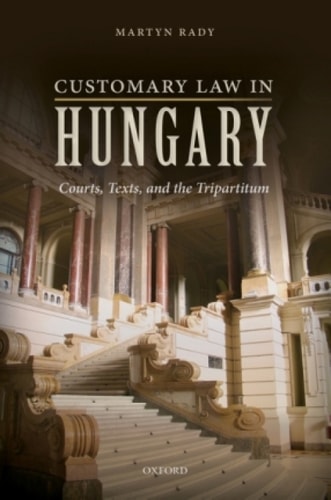
Customary Law in Hungary: Courts, Texts, and the Tripartitum
0
0
As an Amazon Associate and affiliate partner, Menrva Books earns from qualifying purchases. Learn more
Author Description
This is the first comprehensive treatment in any language of the history of customary law in Hungary, from the thirteenth to the twentieth centuries. Hungary's customary law was described by Stephen Werboczy in 1517 in the extensive law code known as the Tripartitum. As Werboczy explained, Hungarian law derived from the interplay of Romano-canonical law, statute, written instruments, and court judgments. It was also responsive, however, to popular conceptions of the law's content and application, as communicated through the lay membership of the kingdom's courts. Publication of the Tripartitum was intended to make the law more certain by fixing it in writing. Nevertheless, its text was customized by actual use, in the same way as the statute laws of the kingdom were adjusted as a consequence of court practice and of errors in their transmission. The reputation attaching to the Tripartitum and Hungary's insulation from the Roman Law Reception meant that the Tripartitum continued to retain authority until well into the nineteenth century. Attempts to replace it foundered and it was the principal text on which the courts and the schools relied, not only in Habsburg Hungary but also in Transylvania. Courts, nevertheless, continued to modify its provisions in the interests of rendering judgments that they deemed either to be right or in conformity with developing practices. Even after the establishment of a parliamentary form of government in the nineteenth century, a strong customary element attached to Hungarian law, which was amplified by the association of customary law with national traditions. The consequence was that Hungary maintained aspects of a customary law regime until the Communist period.
Menrva's Summary
THE THESIS
This book investigates the historical development, application, and enduring authority of customary law in Hungary from the thirteenth to the twentieth centuries. Martyn Rady, a scholar of Central European history, utilizes primary legal texts, court records, and the seminal 1517 Tripartitum to construct a framework for understanding how Hungarian law functioned outside the standard Roman Law Reception. He argues that the law was a dynamic interplay between formal statutes, judicial practice, and popular legal consciousness.
THE SCOPE MAP
What You Will Find
- Analysis of the Tripartitum by Stephen Werboczy
- Examination of the interaction between Romano-canonical law and local custom
- Historical overview of legal practice in Habsburg Hungary and Transylvania
- Evolution of legal authority from the medieval period through the Communist era
Scope Limits
- Does not provide a modern legal handbook or current Hungarian statutory analysis
- Focuses primarily on the historical evolution of customary regimes rather than comparative international law
THE AUTHORITY PERSPECTIVE
Scholars recognize this work as the definitive comprehensive treatment of Hungarian customary law in any language. Experts highlight the text for its meticulous archival research and its ability to clarify the complex relationship between written codes and judicial application.
Page Count:
280
Publication Date:
2015-01-01
Publisher:
OUP Oxford
ISBN-10:
0191061468
ISBN-13:
9780191061462
History
Law
European History
Hungary
Customary Law
Legal History
Law_hungary
Community Tags
Similar Books