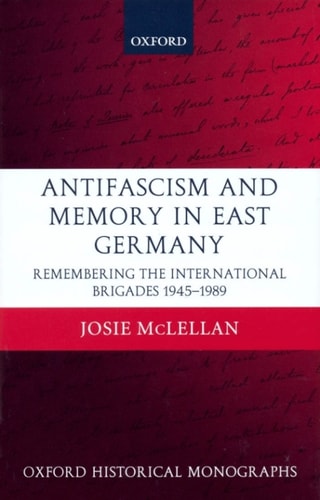
Antifascism and Memory in East Germany: Remembering the International Brigades 1945-1989
0
0
As an Amazon Associate and affiliate partner, Menrva Books earns from qualifying purchases. Learn more
Author Description
AntiFascism and Memory in East Germany is a book about remembering and about forgetting, about war, and about the peace which eventually followed. In the unlikely setting of the German Democratic Republic (GDR), the Spanish Civil War became the subject of a debate which both predated and outlasted the Cold War, involving historians, veterans, politicains, censors, artists, writers, and Church activists. Examining these multiple memories and interpretations of Spain casts new and unexpected light on the legacy of the Spanish Civil War, and the relationship between history and memory under state socialism. The ruling Socialist Unity Party made full use of the antifascist legacy as legitimation for a non-democratic state. But despite dogged attempts at control and censorship, the state was unable to silence competing voices. All over East Germany, International Brigade veterans preserved their version of events - in letters to each other, in communications with the party, in discussions with friends and family around the kitchen table, and in memoirs written for the 'desk drawer'. For younger East Germans, the war retained an undeniably romantic aura. From their perspective, Spain was a far-away land to which they were forbidden to travel, the stuff of camp-fire singalongs and fantasies of adventure. This book dissects the relationship between state-sponsored history, the lobbying of veterans, cultural interpretations of war, and the memory traces left behind by marginalised or politically oppositional groups and individuals. It is a cultural history of memory under state socialism, a social history of veteran groups and their relationship with the state, and a political history of communist culture. Above all, it is the story of how post-war Europeans came to terms with the heavy burden of their pre-war past.
Menrva's Summary
THE THESIS
This book investigates how the memory of the Spanish Civil War was constructed, contested, and utilized within the German Democratic Republic between 1945 and 1989. Josie McLellan, a historian specializing in modern German history, utilizes a wide array of archival materials and personal accounts to analyze the tension between state-sanctioned antifascist narratives and the private, often divergent, memories held by veterans and citizens. The work argues that while the Socialist Unity Party attempted to monopolize the antifascist legacy for political legitimacy, the persistence of individual and group memories created a complex, multi-layered historical landscape that the state could never fully control.
THE SCOPE MAP
What You Will Find
- Analysis of the Socialist Unity Party's use of the International Brigades for state legitimation.
- Examination of private memoirs, correspondence, and oral histories from veterans.
- Cultural history of how the Spanish Civil War was represented in East German literature, art, and public discourse.
- Investigation into the generational divide regarding the romanticization of the conflict.
Scope Limits
- The study focuses specifically on the GDR and does not provide a comprehensive comparative analysis of memory in West Germany.
- The research is bounded by the years 1945 to 1989 and does not cover post-reunification memory politics.
THE AUTHORITY PERSPECTIVE
Scholars recognize this monograph as a significant contribution to the study of memory politics and state socialism in East Germany. Readers frequently note the academic rigor of the prose and the depth of the archival research presented by the author.
Page Count:
240
Publication Date:
2004-01-01
Publisher:
Clarendon Press
ISBN-10:
0191515337
ISBN-13:
9780191515330
History
Political History
German history
European History
Germany history
Social History
Cold War
Community Tags
Similar Books