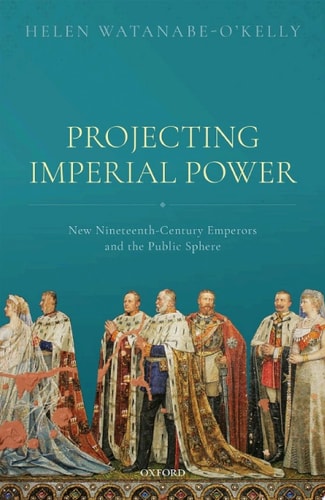
Projecting Imperial Power: New Nineteenth Century Emperors and the Public Sphere
0
0
As an Amazon Associate and affiliate partner, Menrva Books earns from qualifying purchases. Learn more
Author Description
The nineteenth century is notable for its newly proclaimed emperors, from Franz I of Austria and Napoleon I in 1804, through Agustín of Mexico, Pedro I of Brazil, Napoleon III of France, Maximilian of Mexico, and Wilhelm I of Germany, to Victoria, empress of India, in 1876. These monarchs projected an imperial aura through coronations, courts, medals, costumes, portraits, monuments, international exhibitions, festivals, religion, architecture, and town planning. They relied on ancient history for legitimacy while partially espousing modernity. Projecting Imperial Power is the first book to consider together these newly proclaimed emperors in six territories on three continents across the whole of the long nineteenth century. The first emperors' successors—Pedro II of Brazil, Franz Joseph of Austria, and Wilhelm II of Germany—expanded their panoply of power, until Pedro was forced to abdicate in 1889 and the First World War brought the Austrian and German empires to an end. Britain invented an imperial myth for its Indian empire in the twentieth century, but George VI still had to relinquish the title of emperor in 1947. Using a wide range of sources, Projecting Imperial Power explains the imperial ambition behind the cities of Berlin, Paris, Vienna, and New Delhi. It discusses the contested place of the emperors and their empires in national cultural memory by examining how the statues that were erected in huge numbers in the second part of the period are treated today.
Menrva's Summary
THE THESIS
This book investigates how newly proclaimed nineteenth-century emperors utilized public spectacle, architecture, and symbolic representation to construct and maintain imperial legitimacy in an era of encroaching modernity. Helen Watanabe-O'Kelly, a scholar of European court culture, synthesizes historical data across three continents to analyze the intersection of monarchical power and the public sphere. The work argues that these rulers deliberately balanced ancient historical precedents with modern technological and urban developments to project an aura of authority.
THE SCOPE MAP
What You Will Find
- Comparative analysis of imperial regimes in Austria, France, Mexico, Brazil, Germany, and India.
- Examination of symbolic tools including coronations, monuments, international exhibitions, and portraiture.
- Discussion of the transition from nineteenth-century imperial ambition to twentieth-century decline.
Scope Limits
- The study focuses primarily on the visual and performative aspects of power rather than detailed military or economic policy.
- It does not provide an exhaustive biography of every individual emperor mentioned.
THE AUTHORITY PERSPECTIVE
Scholars and historians identify this work as a significant contribution to the study of political performance and the material culture of nineteenth-century empires. Readers frequently note the academic rigor and the breadth of the comparative framework, which effectively connects disparate global imperial projects into a cohesive narrative.
Page Count:
354
Publication Date:
2021-01-01
Publisher:
OUP Oxford
ISBN-10:
0192523376
ISBN-13:
9780192523372
History
Imperialism
Cultural History
Monarchy
European History
Modern History
Community Tags
Similar Books