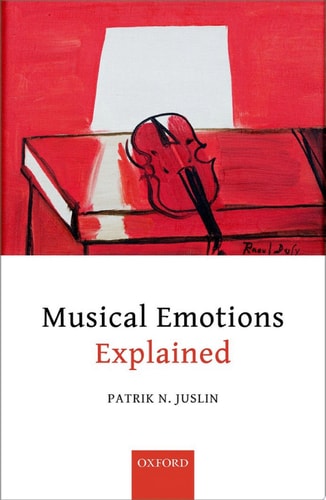
Musical Emotions Explained: Unlocking the Secrets of Musical Affect
0
0
As an Amazon Associate and affiliate partner, Menrva Books earns from qualifying purchases. Learn more
Author Description
Can music really arouse emotions? If so, what emotions, and how? Why do listeners respond with different emotions to the same piece of music? Are emotions to music different from other emotions? Why do we respond to fictional events in art as if they were real, even though we know they're not? What is it that makes a performance of music emotionally expressive? Based on ground-breaking research, Musical Emotions Explained explores how music expresses and arouses emotions, and how it becomes an object of aesthetic judgments. Within the book, Juslin demonstrates how psychological mechanisms from our ancient past engage with meanings in music at multiple levels of the brain to evoke a broad variety of affective states - from startle responses to profound aesthetic emotions. He also explores why these mechanisms respond to music. Written by one of the leading researchers in the field, the book is richly illustrated with music examples from everyday life, and explains with clarity and rigour the manifold ways in which music may engage our emotions.
Menrva's Summary
THE THESIS
This book investigates the psychological and neurological mechanisms that allow music to express and arouse specific emotional states in listeners. Patrik N. Juslin, a prominent researcher in music psychology, synthesizes decades of empirical data to explain why humans respond to musical stimuli with affective states ranging from basic startle reflexes to complex aesthetic experiences. The work posits that music engages ancient evolutionary mechanisms within the brain, bridging the gap between artistic expression and biological response.
THE SCOPE MAP
What You Will Find
- Analysis of psychological mechanisms including brainstem reflexes, evaluative conditioning, and episodic memory.
- Examination of the relationship between musical performance and emotional expression.
- Discussion of aesthetic judgments and the paradox of responding to fictional artistic events.
Scope Limits
- The text focuses primarily on psychological and cognitive perspectives rather than music theory or composition techniques.
- It does not provide a comprehensive history of musicology or cultural studies of music.
THE AUTHORITY PERSPECTIVE
Experts in the field recognize this work as a foundational, single-authored synthesis of current research on musical affect. Readers frequently note the balance between rigorous scientific inquiry and accessible prose, making it suitable for both academic researchers and interested laypeople.
Page Count:
623
Publication Date:
2019-01-01
Publisher:
OUP Oxford
ISBN-10:
0191067768
ISBN-13:
9780191067761
Psychology
Musicology
Neuroscience
Aesthetics
Community Tags
Similar Books