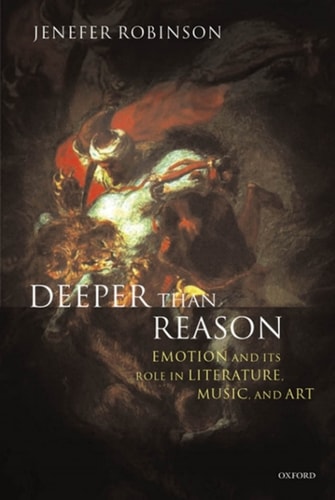
Deeper than Reason: Emotion and Its Role in Literature, Music, and Art
0
0
As an Amazon Associate and affiliate partner, Menrva Books earns from qualifying purchases. Learn more
Author Description
Deeper than Reason takes the insights of modern psychological and neuroscientific research on the emotions and brings them to bear on questions about our emotional involvement with the arts. Robinson begins by laying out a theory of emotion, one that is supported by the best evidence from current empirical work on emotions, and then in the light of this theory examines some of the ways in which the emotions function in the arts. Written in a clear and engaging style, her book will make fascinating reading for anyone who is interested in the emotions and how they work, as well as anyone engaged with the arts and aesthetics, especially with questions about emotional expression in the arts, emotional experience of art forms, and, more generally, artistic interpretation. Part One develops a theory of emotions as processes, having at their core non-cognitive 'instinctive' appraisals, 'deeper than reason', which automatically induce physiological changes and action tendencies, and which then give way to cognitive monitoring of the situation. Part Two examines the role of the emotions in understanding literature, especially the great realistic novels of the nineteenth century. Robinson argues that such works need to be experienced emotionally if they are to be properly understood. A detailed reading of Edith Wharton's novel The Reef demonstrates how a great novel can educate us emotionally by first evoking instinctive emotional responses and then getting us to cognitively monitor and reflect upon them. Part Three puts forward a new Romantic theory of emotional expression in the arts. Part Four deals with music, both the emotional expression of emotion in music, whether vocal or instrumental, and the arousal of emotion by music. The way music arouses emotion lends indirect support to the theory of emotion outlined in Part One. While grounded in the science of emotion, Deeper than Reason demonstrates the continuing importance of the arts and humanities to our lives.
Menrva's Summary
THE THESIS
How do the mechanisms of human emotion inform our engagement with, interpretation of, and creation of art, music, and literature? Jenefer Robinson, a scholar in the field of aesthetics, synthesizes contemporary psychological and neuroscientific research to construct a robust theory of emotion as a dynamic process. She argues that emotions are not merely cognitive judgments but are rooted in instinctive, non-cognitive appraisals that trigger physiological responses, which are subsequently refined through cognitive monitoring. By applying this framework to the humanities, Robinson posits that emotional engagement is a prerequisite for the full comprehension of artistic works.
THE SCOPE MAP
What You Will Find
- A process-based theory of emotion integrating empirical psychological data.
- Analysis of nineteenth-century realistic literature as a vehicle for emotional education.
- A revised Romantic theory regarding the expression of emotion in creative works.
- Examination of both vocal and instrumental music in relation to emotional arousal.
Scope Limits
- The text focuses primarily on Western artistic traditions and specific literary examples.
- It does not provide a comprehensive history of aesthetics, but rather a specific application of emotion theory to art.
THE AUTHORITY PERSPECTIVE
Scholars and readers frequently note the academic density of the prose, which requires a foundational understanding of both philosophy and cognitive science. Experts highlight this as a significant contribution to the field of aesthetics, bridging the gap between empirical science and the humanities.
Page Count:
515
Publication Date:
2005-01-01
Publisher:
Clarendon Press
ISBN-10:
0191532517
ISBN-13:
9780191532511
Psychology
Philosophy
Musicology
Neuroscience
Art Theory
Aesthetics
Literary Criticism
Music
Community Tags
Other Editions(2)

Similar Books
Reader Comments
Share Your Thoughts
No comments yet. Be the first to share your thoughts!