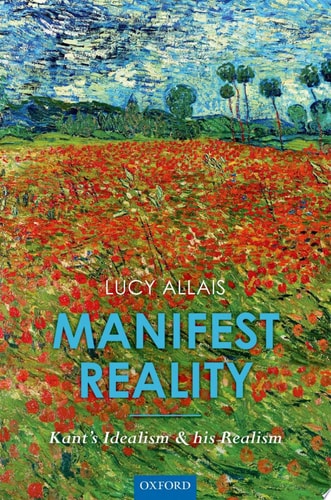
Manifesting Reality: Kant on Appearance, Reality, and Things in Themselves
0
0
As an Amazon Associate and affiliate partner, Menrva Books earns from qualifying purchases. Learn more
Author Description
At The Heart Of Immanuel Kant's Critical Philosophy Is An Epistemological And Metaphysical Position He Calls Transcendental Idealism; The Aim Of This Book Is To Understand This Position. Despite The Centrality Of Transcendental Idealism In Kant's Thinking, In Over Two Hundred Years Since The Publication Of The First Critique There Is Still No Agreement On How To Interpret The Position, Or Even On Whether, And In What Sense, It Is A Metaphysical Position. Lucy Allais Argue That Kant's Distinction Between Things In Themselves And Things As They Appear To Us Has Both Epistemological And Metaphysical Components. He Is Committed To A Genuine Idealism About Things As They Appear To Us, But This Is Not A Phenomenalist Idealism. He Is Committed To The Claim That There Is An Aspect Of Reality That Grounds Mind-dependent Spatio-temporal Objects, And Which We Cannot Cognize, But He Does Not Assert The Existence Of Distinct Non-spatio-temporal Objects. A Central Part Of Allais's Reading Involves Paying Detailed Attention To Kant's Notion Of Intuition, And Its Role In Cognition. She Understands Kantian Intuitions As Representations That Give Us Acquaintance With The Objects Of Thought. Kant's Idealism Can Be Understood As Limiting Empirical Reality To That With Which We Can Have Acquaintance. He Thinks That This Empirical Reality Is Mind-dependent In The Sense That It Is Not Experience-transcendent, Rather Than Holding That It Exists Literally In Our Minds. Reading Intuition In This Way Enables Us To Make Sense Of Kant's Central Argument For His Idealism In The Transcendental Aesthetic, And To See Why He Takes The Complete Idealist Position To Be Established There. This Shows That Reading A Central Part Of His Argument In The Transcendental Deduction As Epistemological Is Compatible With A Metaphysical, Idealist Reading Of Transcendental Idealism.
Menrva's Summary
THE THESIS
This book investigates the core meaning and structure of Immanuel Kant's transcendental idealism, specifically addressing the long-standing debate over whether his position is primarily epistemological or metaphysical. Lucy Allais, a scholar of Kantian philosophy, utilizes a rigorous analysis of the Critique of Pure Reason to argue that Kant’s distinction between things in themselves and appearances contains both epistemological and metaphysical dimensions. She posits that Kantian idealism is not a form of phenomenalism but rather a claim about the limits of human acquaintance with reality.
THE SCOPE MAP
What You Will Find
- A detailed re-examination of the Transcendental Aesthetic and the Transcendental Deduction.
- A specific interpretation of Kantian intuition as a form of acquaintance with objects.
- An analysis of the mind-dependent nature of empirical reality.
Scope Limits
- The text does not provide a general introduction to Kant’s entire moral or political philosophy.
- The analysis is restricted to the specific metaphysical and epistemological claims regarding transcendental idealism.
THE AUTHORITY PERSPECTIVE
Scholars frequently note the technical density of Allais's prose, which requires a strong background in Kantian terminology. Experts highlight this work as a significant contribution to contemporary debates regarding the metaphysical status of Kant's idealism.
Page Count:
320
Publication Date:
2015-01-01
Publisher:
Oup Oxford
ISBN-10:
0191064238
ISBN-13:
9780191064234
Philosophy
Metaphysics
Epistemology
Academic Philosophy
Kant
Community Tags
Similar Books