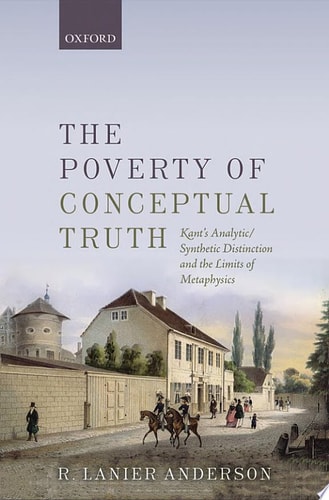
The Poverty of Conceptual Truth
0
0
As an Amazon Associate and affiliate partner, Menrva Books earns from qualifying purchases. Learn more
Author Description
The Poverty Of Conceptual Truth Is Based On A Simple Idea. Kant's Distinction Between Analytic And Synthetic Judgments Underwrites A Powerful Argument Against The Metaphysical Program Of His Leibnizian-wolffian Predecessors—an Argument From Fundamental Limits On Its Expressive Power. In That Tradition, Metaphysics Promised To Reveal The Deep Rational Structure Of The World Through A Systematic Philosophy Consisting Of Strictly Conceptual Truths, Which Flow From A Logically Perspicuous Relation Of 'containment' Among Concepts. That Is, All Truths Would Be 'analytic,' In Kant's Sense. Kant's Distinction Shows To The Contrary That Far Reaching And Scientifically Indispensable Parts Of Our Knowledge Of The World (including Mathematics, The Foundations Of Natural Science, All Knowledge From Experience, And The Central Principles Of Metaphysics Itself) Are Essentially Synthetic And Could Never Be Restated In Analytic Form. Thus, The Metaphysics Of Kant's Predecessors Is Doomed, Because Knowledge Crucial To Any Adequate Theory Of The World Cannot Even Be Expressed In The Idiom To Which It Restricts Itself (and Which Was The Basis Of Its Claim To Provide A Transparently Rational Account Of Things). Traditional Metaphysics Founders On The Expressive Poverty Of Conceptual Truth. To Establish These Claims, R. Lanier Anderson Shows How Kant's Distinction Can Be Given A Clear Basis Within Traditional Logic, And Traces Kant's Long, Difficult Path To Discovering It. Once Analyticity Is Framed In Clear Logical Terms, It Is Possible To Reconstruct Compelling Arguments That Elementary Mathematics Must Be Synthetic, And Then To Show How Similar Considerations About Irreducible Syntheticity Animate Kant's Famous Arguments Against Traditional Metaphysics In The Critique Of Pure Reason.
Menrva's Summary
THE THESIS
This work investigates the fundamental limitations of the Leibnizian-Wolffian metaphysical program by analyzing Kant's distinction between analytic and synthetic judgments. R. Lanier Anderson, a scholar of Kantian philosophy, utilizes historical logical frameworks to argue that traditional metaphysics fails because it relies on an expressive idiom incapable of capturing essential synthetic knowledge. By reconstructing Kant's development of the analytic-synthetic distinction, the author demonstrates that critical components of human knowledge—including mathematics and natural science—cannot be reduced to mere conceptual containment.
THE SCOPE MAP
What You Will Find
- A logical reconstruction of Kant's analytic-synthetic distinction.
- An analysis of the Leibnizian-Wolffian metaphysical tradition.
- Arguments regarding the irreducibility of synthetic knowledge in mathematics and science.
Scope Limits
- The text does not provide a general introduction to Kant's entire philosophical system.
- The analysis focuses primarily on the logical and metaphysical implications of the distinction rather than Kant's moral or aesthetic philosophy.
THE AUTHORITY PERSPECTIVE
Scholars recognize this text as a rigorous contribution to the study of Kant's logic and his critique of rationalist metaphysics. Readers frequently note the technical density of the prose, which assumes a high level of familiarity with both Kantian terminology and traditional logic.
Page Count:
384
Publication Date:
2015-01-01
Publisher:
Oup Oxford
ISBN-10:
0191036846
ISBN-13:
9780191036842
Philosophy
Kant
Metaphysics
Epistemology
Philosophy history
Community Tags
Similar Books