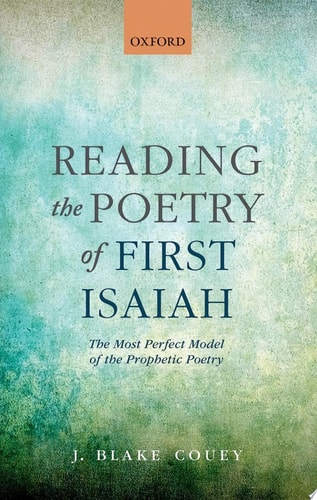
Reading the Poetry of First Isaiah: The Most Perfect Model of the Prophetic Poetry
0
0
As an Amazon Associate and affiliate partner, Menrva Books earns from qualifying purchases. Learn more
Author Description
Reading the Poetry of First Isaiah provides a literary and historical study of the prophetic poetry of First Isaiah, an underappreciated but highly sophisticated collection of poems in the Hebrew Bible. Informed by recent developments in biblical studies and broader trends in the study of poetry, Dr J. Blake Couey articulates a fresh account of Biblical Hebrew poetry and argues that careful attention to poetic style is crucial for the interpretation of these texts. Discussing lineation, he explains that lines serve important rhetorical functions in First Isaiah, but the absence of lineated manuscripts from antiquity makes it necessary to defend proposed line divisions using criteria such as parallelism, rhythm, and syntax. He examines poetic structure, and highlights that parallelism and enjambment create a sense of progression between individual lines, which are tightly joined to form couplets, triplets, quatrains, and occasionally even longer groups. Later, Dr Couey treats imagery and metaphor in First Isaiah. A striking variety of images-most notably agricultural and animal imagery-appear in diverse contexts in these poems, often with rich figurative significance.
Menrva's Summary
THE THESIS
This work investigates how the application of modern literary theory and poetic analysis can resolve long-standing interpretive challenges within the prophetic texts of First Isaiah. Dr. J. Blake Couey, a scholar in biblical studies, utilizes recent developments in linguistics and poetic structure to argue that the formal arrangement of these poems is essential to understanding their theological and rhetorical impact. By examining the interplay between syntax, rhythm, and imagery, the author provides a framework for reading these ancient texts with greater precision.
THE SCOPE MAP
What You Will Find
- Analysis of lineation and its rhetorical function in Hebrew prophetic poetry
- Methodologies for determining line divisions using parallelism, rhythm, and syntax
- Examination of poetic structures including couplets, triplets, and quatrains
- Study of agricultural and animal imagery within the text
Scope Limits
- The study focuses specifically on First Isaiah and does not provide a comprehensive analysis of the entire Book of Isaiah
- The text does not offer a historical-critical commentary on the entirety of the prophetic narrative
THE AUTHORITY PERSPECTIVE
Scholars and students of biblical literature frequently note the technical rigor of the author's approach to Hebrew poetic structure. Experts highlight this as a significant contribution to the study of prophetic rhetoric, particularly for those seeking to bridge the gap between historical context and literary form.
Page Count:
272
Publication Date:
2015-01-01
Publisher:
OUP Oxford
ISBN-10:
0191061204
ISBN-13:
9780191061202
Religion
Bibles
Criticism history
Literary Criticism
Hebrew Bible
Theology
Community Tags
Similar Books