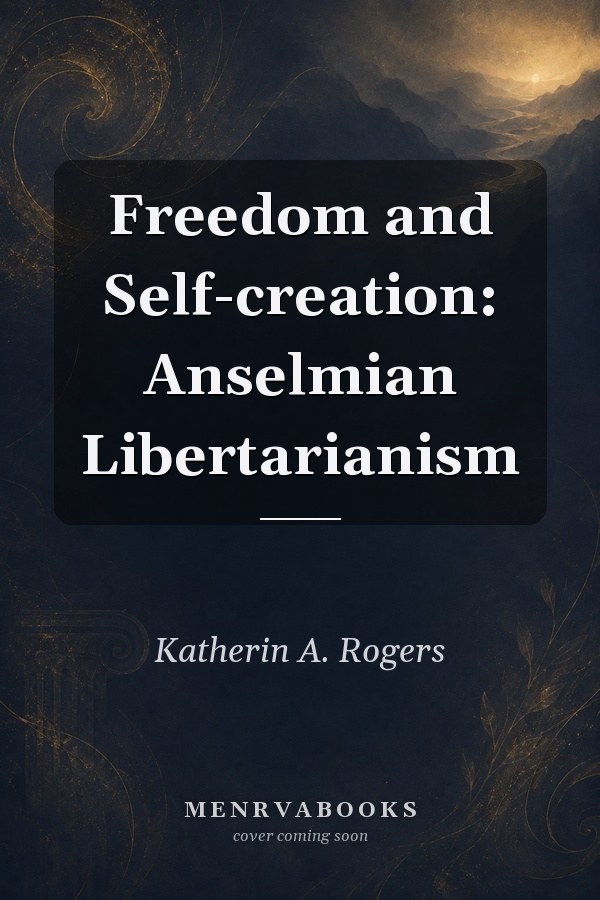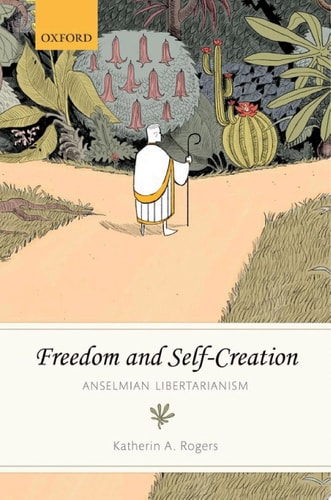
Freedom and Self-Creation: Anselmian Libertarianism
0
0
As an Amazon Associate and affiliate partner, Menrva Books earns from qualifying purchases. Learn more
Author Description
Katherin A. Rogers presents a new theory of free will, based on the thought of Anselm of Canterbury. We did not originally produce ourselves. Yet, according to Anselm, we can engage in self-creation, freely and responsibly forming our characters by choosing 'from ourselves' (a se) between open options. Anselm introduces a new, agent-causal libertarianism which is parsimonious in that, unlike other agent-causal theories, it does not appeal to any unique and mysterious powers to explain how the free agent chooses. After setting out Anselm's original theory, Rogers defends and develops it by addressing a series of standard problems levelled against libertarianism. These include the problem of 'internalism--in that an agent is not the source of his original motivations, how can the structure of his choice ground his responsibility?; the problem of Frankfurt-style counterexamples--Do we really need open options to choose freely?; and the problem of luck--If nothing about an agent before he chooses explains his choice, then isn't the choice just dumb luck? (The Anselmian answer to this perennial criticism is especially innovative, proposing that the critic has the relationship between choices and character exactly backwards.) Finally, as a theory about self-creation, Anselmian Libertarianism must defend the tracing thesis, the claim that an agent can be responsible for character-determined choices, if he, himself, formed his character through earlier a se choices. Throughout, the book defends and exemplifies a new methodological suggestion: someone debating free will ought to make his background world view explicit. In the on-going debate over the possibility of human freedom and responsibility, Anselmian Libertarianism constitutes a new and plausible approach.
Menrva's Summary
THE THESIS
This book investigates whether human beings can possess genuine free will and moral responsibility through a process of self-creation, utilizing the philosophical framework of Anselm of Canterbury. Katherin A. Rogers, a scholar specializing in medieval philosophy, reconstructs Anselm’s agent-causal libertarianism to propose a model of freedom that avoids the need for mysterious or non-natural powers. By grounding the theory in Anselmian thought, she argues that individuals can be responsible for their character-forming choices even when those choices are not determined by prior motivations.
THE SCOPE MAP
What You Will Find
- A systematic reconstruction of Anselm of Canterbury's theory of free will.
- An agent-causal libertarian model that emphasizes the concept of choosing 'from ourselves' (a se).
- A defense of the tracing thesis regarding character-determined actions.
- Counter-arguments to internalism, Frankfurt-style cases, and the problem of luck.
Scope Limits
- The text does not provide a comprehensive history of all libertarian theories.
- It does not address non-theistic or purely secular metaphysical frameworks outside of the Anselmian context.
THE AUTHORITY PERSPECTIVE
Scholars and philosophers frequently note the rigor with which Rogers applies medieval concepts to contemporary debates on agency. Experts highlight this work as a significant contribution to the literature for its innovative approach to the problem of luck and its clear articulation of Anselmian metaphysics.
Page Count:
254
Publication Date:
2015-01-01
Publisher:
OUP Oxford
ISBN-10:
0191061549
ISBN-13:
9780191061547
Philosophy
Autopoiesis
Metaphysics
Free Will
Ethics
Anselm of Canterbury