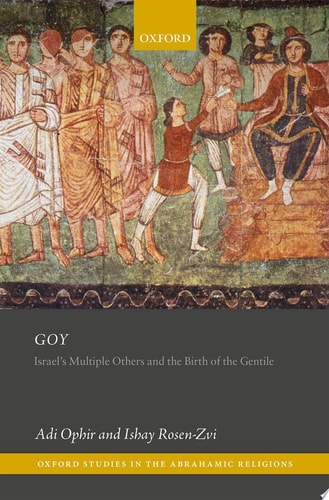
Goy: Israel's Others and the Birth of the Gentile
0
0
As an Amazon Associate and affiliate partner, Menrva Books earns from qualifying purchases. Learn more
Author Description
Goy: Israel's Others And The Birth Of The Gentile Traces The Development Of The Term And Category Of The Goy From The Bible To Rabbinic Literature. Adi Ophir And Ishay Rosen-zvi Show That The Category Of The Goy Was Born Much Later Than Scholars Assume; In Fact Not Before The First Century Ce. They Explain That The Abstract Concept Of The Gentile First Appeared In Paul's Letters. However, It Was Only In Rabbinic Literature That This Category Became The Center Of A Stable And Long Standing Structure That Involved God, The Halakha, History, And Salvation. The Authors Narrate This Development Through Chronological Analyses Of The Various Biblical And Post Biblical Texts (including The Dead Sea Scrolls, The New Testament And Early Patristics, The Mishnah, And Rabbinic Midrash) And Synchronic Analyses Of Several Discursive Structures. Looking At Some Of The Goy's Instantiations In Contemporary Jewish Culture In Israel And The United States, The Study Concludes With An Examination Of The Extraordinary Resilience Of The Jew/goy Division And Asks How Would Judaism Look Like Without The Gentile As Its Binary Contrast.
Menrva's Summary
THE THESIS
This work investigates the historical origins and conceptual evolution of the category of the 'goy' within Jewish thought and its enduring impact on Jewish identity. Adi Ophir and Ishay Rosen-Zvi, both scholars of philosophy and Jewish studies, utilize a combination of historical analysis and discourse theory to challenge the assumption that the term existed in the biblical period. They argue that the abstract concept of the Gentile emerged in the first century CE, primarily through Pauline letters, before being solidified into a central structural binary within Rabbinic literature.
THE SCOPE MAP
What You Will Find
- Chronological analysis of biblical and post-biblical texts including the Dead Sea Scrolls and the New Testament.
- Examination of Rabbinic literature, specifically the Mishnah and Midrash.
- Synchronic analysis of discursive structures regarding the Jew/goy binary.
- Investigation into contemporary manifestations of the category in Israel and the United States.
Scope Limits
- The study does not provide an exhaustive history of all inter-religious relations in the ancient world.
- It does not focus on the sociological experiences of non-Jews themselves, but rather on the construction of the category within Jewish discourse.
THE AUTHORITY PERSPECTIVE
Scholars and readers frequently note the academic density and rigorous philological approach of this text. Experts highlight this as a significant contribution to the study of Jewish identity formation and the history of religious categorization.
Page Count:
384
Publication Date:
2018-01-01
Publisher:
Oxford University Press
ISBN-10:
0191062340
ISBN-13:
9780191062346
History
Religion
Theology
Sociology
Judaism
Community Tags
Similar Books