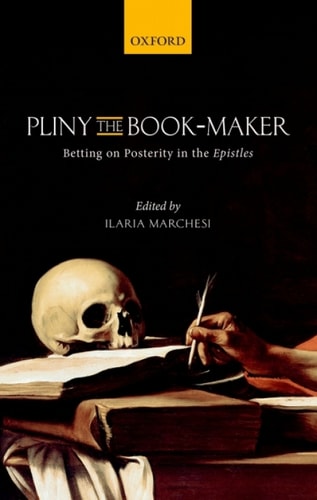
Pliny the Book-Maker: Betting on Posterity in the Epistles
0
0
As an Amazon Associate and affiliate partner, Menrva Books earns from qualifying purchases. Learn more
Author Description
What did it mean - in terms of social, cultural, and literary negotiations - to publish one's own work in Rome at the end of the first century CE? What kinds of traces has the author's work as editor left on the text as we read it? How can we interpret them? What kind of well-choreographed balancing act was needed to ensure immediate availability and success for one's work in terms of its historical contemporary audience, while guaranteeing its long-lasting appeal with a hypothetical one? These are the key questions behind the essays in this collection, as they address Pliny the Younger's complex self-editorial strategies, and what they were intended to achieve. The individual studies use philological and interpretive arguments to reveal that Pliny's nine-book collection of private epistles is a carefully arranged work designed, ultimately (and primarily), to address that peculiar kind of audience that we have come to conceptualize as posterity. In doing so, they suggest that in the collected form of the Epistles meaning is produced by the interplay of multiple factors. Immediate context, placement in the book, linkage achieved by way of formal or thematic patterns, recurrence of addressees, happenings, and dates all impact individual texts in Pliny's collection and charge them with sense. Pliny the Book-Maker is intended as a contribution to the larger recent re-orientation of Pliny studies, which looks to shift the focus of analysis from strictly socio-historical data-mining to a literary re-evaluation of Pliny's texts.
Menrva's Summary
THE THESIS
This collection investigates how Pliny the Younger utilized self-editorial strategies to curate his private epistles for both contemporary Roman readers and future posterity. Author Ilaria Marchesi and contributors analyze the literary construction of Pliny's nine-book collection, moving beyond traditional socio-historical data-mining. The essays argue that the meaning of the Epistles is generated through the deliberate arrangement, thematic linkage, and structural placement of individual letters within the larger work.
THE SCOPE MAP
What You Will Find
- Analysis of Pliny the Younger's editorial techniques and self-presentation.
- Examination of the interplay between immediate historical context and long-term literary intent.
- Philological and interpretive studies of thematic patterns and addressee recurrence.
Scope Limits
- The text does not provide a comprehensive biography of Pliny the Younger.
- It does not focus on the political history of the first century CE outside of its relevance to Pliny's literary output.
THE AUTHORITY PERSPECTIVE
Scholars identify this work as a significant contribution to the modern re-evaluation of Pliny's texts as deliberate literary artifacts rather than mere historical documents. Readers frequently note the academic density of the prose, which is intended for specialists in Latin literature and classical studies.
Page Count:
312
Publication Date:
2015-01-01
Publisher:
OUP Oxford
ISBN-10:
0191045764
ISBN-13:
9780191045769
History
English
Latin
Writing
Epistolary
Criticism history
Roman History
Ancient History
Literary Criticism
World Languages
English & College Success
Community Tags
Similar Books














