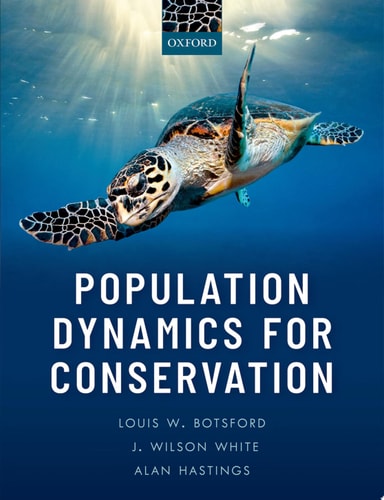
Population Dynamics for Conservation
0
0
As an Amazon Associate and affiliate partner, Menrva Books earns from qualifying purchases. Learn more
Author Description
The management and conservation of natural populations relies heavily on concepts and results generated from models of population dynamics. Yet this is the first book to present a unified and coherent explanation of the underlying theory. This novel text begins with a consideration of what makes a good state variable, progressing from the simplest models (those with a single variable such as abundance or biomass) to more complex models with other key variables of population structure (including age, size, life history stage, and space). Throughout the book, attention is paid to concepts such as population variability, population stability, population viability/persistence, and harvest yield. Later chapters address specific applications to conservation such as recovery planning for species at risk, fishery management, and the spatial management of marine resources. Population Dynamics for Conservation is suitable for graduate-level students. It will also be valuable to academic and applied researchers in population biology. This overview of population dynamic theory can serve to further their population research, as well as to improve their understanding of population management.
Menrva's Summary
THE THESIS
How can mathematical models of population dynamics be systematically applied to the management and conservation of natural species? The authors, Alan Hastings, J. Wilson White, and Louis W. Botsford, leverage their extensive academic backgrounds in theoretical ecology to synthesize disparate modeling approaches into a unified framework. They argue that understanding the selection of state variables is the foundational step for predicting population stability, viability, and harvest potential in diverse environments.
THE SCOPE MAP
What You Will Find
- Mathematical modeling of population abundance and biomass
- Analysis of population structure variables including age, size, and life history stages
- Theoretical frameworks for population variability and persistence
- Practical applications for recovery planning and marine resource management
Scope Limits
- The text assumes a high level of mathematical literacy and prior knowledge of ecological principles
- It does not provide a comprehensive survey of all existing ecological software tools
THE AUTHORITY PERSPECTIVE
Experts identify this work as a foundational text for graduate-level students and researchers in population biology. Readers frequently note the technical density of the prose, which serves as a rigorous bridge between theoretical modeling and applied conservation practice.
Page Count:
352
Publication Date:
2019-01-01
Publisher:
OUP Oxford
ISBN-10:
0191075914
ISBN-13:
9780191075919
Science
Ecology
Conservation
Mathematics
Biology