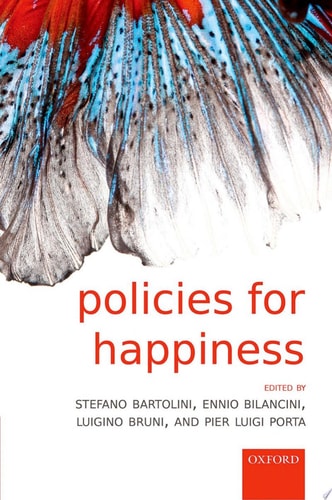
Policies for Happiness
0
0
As an Amazon Associate and affiliate partner, Menrva Books earns from qualifying purchases. Learn more
Author Description
In recent years, debates on the economics of happiness have shown that, over the long-term, well-being is influenced more by social and personal relationships than by income. This evidence challenges the traditional economic policy paradigm that has emphasized income as the primary determinant of well-being. This volume brings together contributions from leading scholars to ask: What should be done to improve the quality of people's lives? Can economic and social changes be made which enhance well-being? What policies are required? How do policies for well-being differ from traditional ones targeted on redistribution, the correction of market inefficiencies, and growth? Are there dimensions of well-being that have been neglected by traditional policies? Is happiness a meaningful policy target? The volume presents reflections and proposals which constitute a first step towards answering these questions.
Menrva's Summary
THE THESIS
This volume investigates whether economic and social policies can be reoriented to prioritize human well-being over traditional income-based growth metrics. The authors, Ennio Bilancini, Luigino Bruni, and Stefano Bartolini, curate a collection of scholarly contributions that challenge the standard economic paradigm. By synthesizing research on the impact of social relationships on long-term satisfaction, the text proposes a framework for evaluating policy effectiveness through the lens of happiness rather than mere market efficiency.
THE SCOPE MAP
What You Will Find
- Comparative analysis between income-focused policies and well-being-centered approaches
- Theoretical frameworks for measuring happiness as a policy target
- Proposals for structural social and economic reform
Scope Limits
- Does not provide a singular, universal policy manual for all nations
- Does not focus on individual psychological self-help techniques
THE AUTHORITY PERSPECTIVE
Experts recognize this volume as a significant contribution to the burgeoning field of happiness economics. Readers frequently note that the text provides a rigorous academic foundation for those interested in the intersection of public policy and social welfare.
Page Count:
320
Publication Date:
2016-01-01
Publisher:
OUP Oxford
ISBN-10:
019107652X
ISBN-13:
9780191076527
Economics
Macroeconomic Theory
well being
Public Policy
Cultural Anthropology
Social Science
Community Tags
Similar Books