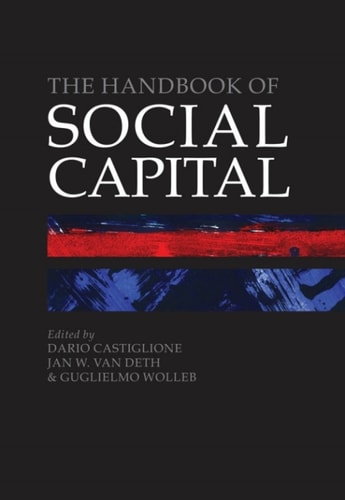
The Handbook of Social Capital
0
0
As an Amazon Associate and affiliate partner, Menrva Books earns from qualifying purchases. Learn more
Author Description
Social capital is a relatively new concept in the social sciences. In the last twenty or so years it has come to indicate that networks of social relationships represent a 'resource' for both the individual and society, since they provide support for the individual and facilitate collective action. Although this is not an entirely new idea, the more systematic way in which social capital captures such an intuition has created a new theoretical paradigm and helped to develop a series of innovative research programmes in politics, economics, and the study of human well-being. The concept has gained currency beyond academia, extending its influence to political and policy-making circles at local, national, and international levels. It has also affected the way in which social surveys are conceived and public policies assessed. As the idea of social capital has spread, the literature about it has increased exponentially. After twenty years of rapid expansion it is time for a more considered and critical assessment of how the original concept has been adapted and refined, and how successful its application has been. The Handbook of Social Capital intends to do precisely that. It offers a state-of-the-art view of discussions about the concept of social capital and the way in which it has been applied in empirical research. The organization of the Handbook reflects this intention by focusing on conceptual development and analysis in the first part; by identifying two main areas of research in which social capital has favoured the development of new and influential research programmes - political participation in democratic societies, and economic development; and by exploring the more normative and policy oriented consequences of social capital. All chapters comprising the volume were specifically written for the Handbook by some of the main experts in the fields. The book provides authoritative and innovative introduction to the study of social capital.
Menrva's Summary
THE THESIS
This volume investigates the theoretical evolution, empirical application, and normative implications of social capital as a central paradigm in contemporary social science. The editors, Dario Castiglione, Guglielmo Wolleb, and Jan W. van Deth, curate contributions from leading experts to evaluate how the concept has transitioned from a niche idea into a foundational framework for analyzing political participation, economic development, and public policy. The text provides a systematic assessment of the literature, addressing both the successes and the limitations of social capital research over the past two decades.
THE SCOPE MAP
What You Will Find
- Conceptual analysis of social capital as a resource for individuals and society
- Examination of social capital within democratic political participation
- Analysis of the role of social capital in economic development frameworks
- Exploration of normative and policy-oriented consequences
- State-of-the-art reviews of empirical research methodologies
Scope Limits
- Does not provide a singular, unified definition of social capital, reflecting the ongoing academic debate
- Focuses primarily on political and economic applications rather than purely psychological or micro-social interactions
THE AUTHORITY PERSPECTIVE
Experts identify this volume as a comprehensive and authoritative resource for scholars and policy-makers seeking to understand the breadth of social capital research. Readers frequently note the academic density of the prose, which is tailored for researchers and advanced students within the social sciences.
Page Count:
744
Publication Date:
2008-01-01
Publisher:
Oxford University Press
ISBN-10:
0191556572
ISBN-13:
9780191556579
Economics
Macroeconomic Theory
Sociology
Public Policy
Social Science
Community Tags
Other Editions(2)
Similar Books







Reader Comments
Share Your Thoughts
No comments yet. Be the first to share your thoughts!