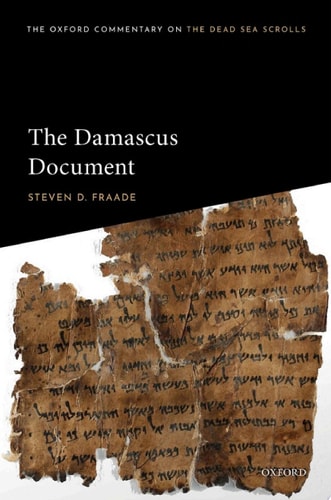
The Damascus Document: Oxford Commentary on the Dead Sea Scrolls
0
0
As an Amazon Associate and affiliate partner, Menrva Books earns from qualifying purchases. Learn more
Author Description
Steve D. Fraade offers a new translation, with notes, and detailed commentary to the Dead Sea Scroll most commonly called the Damascus Document, based on both ancient manuscripts from caves along the western shore of the Dead Sea, and medieval manuscripts from the Cairo Geniza. The text is one of the longest and most important of the Dead Sea Scrolls. Its importance derives from several aspects of its contents: its extensive collections of laws, both for the sectarian community that authored it and for the rest of Israel; some of the oldest examples of scriptural interpretation, both legal and narrative, both implicit and explicit, with important implications for our understanding of the evolving status of the Hebrew canon; some of the clearest expressions, often in hortatory form, of the community's self-understanding as an elect remnant of Israel that understands itself in dualistic opposition to the rest of Israel, its practices, and its leaders; important expressions of the community's self-understanding as a priestly alternative to the sacrificial worship in the Jerusalem Temple; expressions of an apocalyptic, eschatological understanding of living as the true Israel in the "end of days;" important expressions of attitudes toward woman, sexual activity, and marriage; importance for our understanding of ancient modes of teaching and of ritual practice; importance for the study of the history of the Hebrew language and its scribal practices. The volume contains a substantial introduction, dealing with these aspects of the Damascus Document and locating its place within the Dead Sea Scrolls more broadly as well as the historical context of ancient Judaism that gave rise to this text.
Menrva's Summary
THE THESIS
This volume investigates the historical, legal, and theological significance of the Damascus Document within the context of ancient Jewish sectarianism and the development of the Hebrew canon. Steven D. Fraade, a specialist in early rabbinic and sectarian literature, synthesizes evidence from both the Qumran cave manuscripts and the Cairo Geniza fragments. He argues that the document serves as a critical lens for understanding the community's self-definition as an elect remnant, their legal interpretations, and their eschatological worldview.
THE SCOPE MAP
What You Will Find
- A comprehensive translation of the Damascus Document based on multiple manuscript sources.
- Detailed analysis of sectarian legal codes and scriptural interpretation methods.
- Examination of the community's views on marriage, gender, and priestly alternatives to Temple worship.
Scope Limits
- The text focuses primarily on the Damascus Document itself rather than providing a general history of all Dead Sea Scrolls.
- It does not offer a comparative analysis of every minor fragment found in the region.
THE AUTHORITY PERSPECTIVE
Scholars recognize this work as a rigorous and foundational resource for those studying the intersection of sectarian law and early Jewish history. The prose is dense and academic, making it most suitable for students and researchers familiar with the complexities of the Dead Sea Scrolls.
Page Count:
205
Publication Date:
2021-01-01
Publisher:
OUP Oxford
ISBN-10:
0191083526
ISBN-13:
9780191083525
History
Religion
Judaism
Dead Sea Scrolls
Archaeology
Community Tags
Similar Books