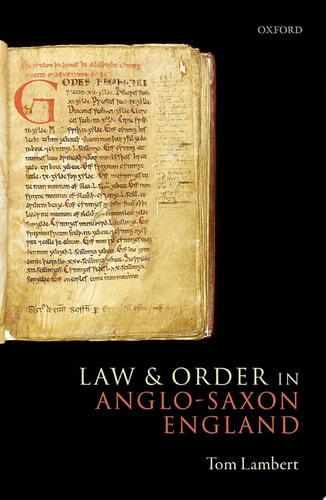
Law and Order in Anglo-Saxon England
0
0
As an Amazon Associate and affiliate partner, Menrva Books earns from qualifying purchases. Learn more
Author Description
Law and Order in Anglo-Saxon England explores English legal culture and practice across the Anglo-Saxon period, beginning with the essentially pre-Christian laws enshrined in writing by King Æthelberht of Kent in c. 600 and working forward to the Norman Conquest of 1066. It attempts to escape the traditional retrospective assumptions of legal history, focused on the late twelfth-century Common Law, and to establish a new interpretative framework for the subject, more sensitive to contemporary cultural assumptions and practical realities. The focus of the volume is on the maintenance of order: what constituted good order; what forms of wrongdoing were threatening to it; what roles kings, lords, communities, and individuals were expected to play in maintaining it; and how that worked in practice. Its core argument is that the Anglo-Saxons had a coherent, stable, and enduring legal order that lacks modern analogies: it was neither state-like nor stateless, and needs to be understood on its own terms rather than as a variant or hybrid of these models. Tom Lambert elucidates a distinctively early medieval understanding of the tension between the interests of individuals and communities, and a vision of how that tension ought to be managed that, strikingly, treats strongly libertarian and communitarian features as complementary. Potentially violent, honour-focused feuding was an integral aspect of legitimate legal practice throughout the period, but so too was fearsome punishment for forms of wrongdoing judged socially threatening. Law and Order in Anglo-Saxon England charts the development of kings' involvement in law, in terms both of their authority to legislate and their ability to influence local practice, presenting a picture of increasingly ambitious and effective royal legal innovation that relied more on the cooperation of local communal assemblies than kings' sparse and patchy network of administrative officials.
Menrva's Summary
THE THESIS
This book investigates how Anglo-Saxon society maintained legal order and social stability between 600 and 1066, challenging the assumption that early medieval law was merely a precursor to later Common Law. Tom Lambert, a specialist in early medieval history, utilizes primary legal texts and historical records to argue that the Anglo-Saxon legal system was a coherent, distinct structure that functioned without modern state-like administrative apparatus. He posits that the system successfully balanced individual libertarian interests with communitarian obligations, creating a unique framework that integrated honor-based feuding with royal legislative authority.
THE SCOPE MAP
What You Will Find
- Analysis of legal codes from King Æthelberht of Kent to the Norman Conquest.
- Examination of the interplay between royal authority and local communal assemblies.
- Investigation into the role of feuding as a legitimate component of legal practice.
- Assessment of how social order was maintained through both community cooperation and royal intervention.
Scope Limits
- The text does not focus on the evolution of post-1066 Common Law.
- It does not provide a comprehensive biography of individual Anglo-Saxon monarchs.
THE AUTHORITY PERSPECTIVE
Scholars recognize this work as a significant re-evaluation of early medieval legal structures that moves away from traditional retrospective biases. Readers frequently note the academic density of the prose, which is intended for those with a background in medieval history or legal studies.
Page Count:
406
Publication Date:
2017-01-01
Publisher:
OUP Oxford
ISBN-10:
0191089605
ISBN-13:
9780191089602
History
Political History
Legal History
Great Britain
European History
Community Tags
Similar Books