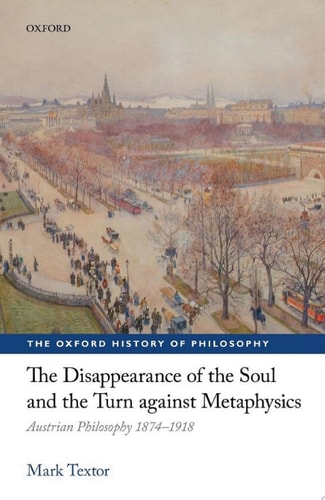
The Disappearance of the Soul and the Turn against Metaphysics: Austrian Philosophy 1874-1918
0
0
As an Amazon Associate and affiliate partner, Menrva Books earns from qualifying purchases. Learn more
Author Description
In the twentieth century English-language philosophy came to be science- and logic-oriented, and was suspicious of metaphysics. The Disappearance of the Soul and the Turn against Metaphysics traces our present philosophical outlook back to debates in Austro-German philosophy about the relation between empirical science and metaphysics: does empirical psychology depend on the metaphysics of the soul, the mental substance? The negative answer - that there is 'a psychology without a soul' - shaped Austrian philosophy and provided a model for ontologies that dispense with substances. Mark Textor tells the story of how and why (Austrian) philosophy turned against metaphysics. He introduces the key thinkers of the time, including the 'fathers of Austrian philosophy' Franz Brentano and Ernst Mach, whose Intentionalism (Brentano) and Neutral Monism (Mach) became distinctive and influential positions in the philosophy of mind. Textor goes on to use the 'psychology without a soul' view as a vantage point from which to reconstruct and assess the immediate pre-history and formation of analytic philosophy (Ward, Stout, Moore, Russell). While Austrian philosophers retired the soul, early analytic philosophers were happy to introduce a successor, the subject, and conceive of the mental as constituted by subject-object relations. The final part of the book returns to the theme of anti-metaphysics from a different perspective. In this part the early Moritz Schlick, who would soon become the leading figure of the Vienna Circle, takes centre stage. The final part of the book reconstructs Schlick's arguments for the conclusion that metaphysics lies beyond the limits of knowledge that are rooted in the philosophy of mind discussed in previous parts.
Menrva's Summary
THE THESIS
This book investigates the historical transition in Austro-German philosophy from a metaphysics-centered view of the soul to an empirical, science-oriented rejection of mental substances. Mark Textor, a scholar of philosophy, utilizes archival debates and primary texts from the late 19th and early 20th centuries to argue that the emergence of 'psychology without a soul' served as a foundational shift for both Austrian and early analytic philosophy. By examining the work of figures like Brentano, Mach, and Schlick, the text maps how these thinkers dismantled traditional metaphysical frameworks to prioritize empirical inquiry and subject-object relations.
THE SCOPE MAP
What You Will Find
- Historical analysis of the shift from mental substance to empirical psychology between 1874 and 1918.
- Detailed examination of Intentionalism and Neutral Monism as philosophical responses to the soul.
- Comparative study of Austrian philosophy and the early analytic tradition represented by Moore and Russell.
- Reconstruction of Moritz Schlick’s arguments regarding the limits of knowledge and the rejection of metaphysics.
Scope Limits
- The analysis focuses primarily on the Austro-German tradition and its specific influence on analytic philosophy rather than a comprehensive history of all 20th-century metaphysics.
- The text does not provide an exhaustive biography of the philosophers mentioned, focusing instead on their specific contributions to the anti-metaphysical turn.
THE AUTHORITY PERSPECTIVE
Experts recognize this work as a rigorous contribution to the history of analytic philosophy, noting its success in bridging the gap between Austrian traditions and the broader Anglo-American canon. Readers frequently highlight the density of the prose, which demands a strong background in philosophical terminology to fully grasp the nuanced arguments regarding mental substance.
Page Count:
402
Publication Date:
2021-01-01
Publisher:
OUP Oxford
ISBN-10:
019108249X
ISBN-13:
9780191082498
Philosophy
History & Surveys
Philosophy of
Austrian Philosophy
Philosophy history
Metaphysics
Community Tags
Similar Books