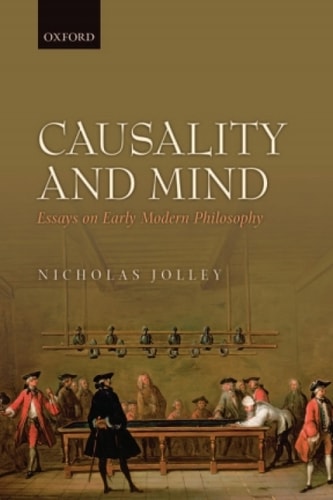
Causality and Mind: Essays on Early Modern Philosophy
0
0
As an Amazon Associate and affiliate partner, Menrva Books earns from qualifying purchases. Learn more
Author Description
Causality and Mind presents seventeen of Nicholas Jolley's essays on early modern philosophy, which focus on two main themes. One theme is the continuing debate over the nature of causality in the period from Descartes to Hume. Jolley shows that, despite his revolutionary stance, Descartes did no serious re-thinking about causality; it was left to his unorthodox disciple Malebranche to argue that there is no place for natural causality in the new mechanistic picture of the physical world. Several essays explore critical reactions to Malebranche's occasionalism in the writings of Leibniz, Berkeley, and Hume, and show how in their different ways Leibniz and Hume respond to Malebranche by re-instating the traditional view that science is the search for causes. A second theme of the volume is the set of issues posed by Descartes' innovations in the philosophy of mind. It is argued that Malebranche is once again a pivotal figure. In opposition to Descartes Malebranche insists that ideas, the objects of thought, are not psychological but abstract entities; he thus opposes Descartes' 'dustbin theory of the mind'. Malebranche also challenges Descartes' assumption that intentionality is a mark of the mental and his commitment to the superiority of self-knowledge over knowledge of body. Other essays discuss the debate over innate ideas, Locke's polemics against Descartes' theory of mind, and the issue of Leibniz's phenomenalism. A major aim of the volume is to show that philosophers in the period are systematic critics of their contemporaries and predecessors.
Menrva's Summary
THE THESIS
This volume investigates the evolution of causal theory and philosophy of mind from Descartes to Hume, arguing that Malebranche serves as a pivotal, often overlooked figure in these intellectual shifts. Nicholas Jolley, a scholar of early modern thought, compiles seventeen essays that examine how seventeenth and eighteenth-century philosophers engaged in systematic critique of their predecessors. The work posits that the mechanistic worldview necessitated a radical re-evaluation of causality and the nature of mental intentionality.
THE SCOPE MAP
What You Will Find
- Analysis of the transition from Cartesian mechanics to Malebranche's occasionalism.
- Examination of Leibniz, Berkeley, and Hume's responses to causal skepticism.
- Critique of the 'dustbin theory of the mind' and the status of innate ideas.
- Comparative studies of Locke, Descartes, and Leibniz regarding phenomenalism and self-knowledge.
Scope Limits
- The text does not provide a comprehensive history of all early modern philosophical schools.
- It focuses primarily on the specific lineage of rationalist and empiricist responses to Cartesian innovation.
THE AUTHORITY PERSPECTIVE
Scholars recognize this collection as a rigorous examination of the internal debates that defined the early modern period. Readers frequently note the academic density of the prose, which assumes a foundational knowledge of the primary texts discussed.
Page Count:
279
Publication Date:
2013-01-01
Publisher:
OUP Oxford
ISBN-10:
0191648329
ISBN-13:
9780191648328
Philosophy
Metaphysics
Philosophy of
Early Modern
Causation
History & Surveys
Philosophy history
Community Tags
Other Editions(2)

Similar Books