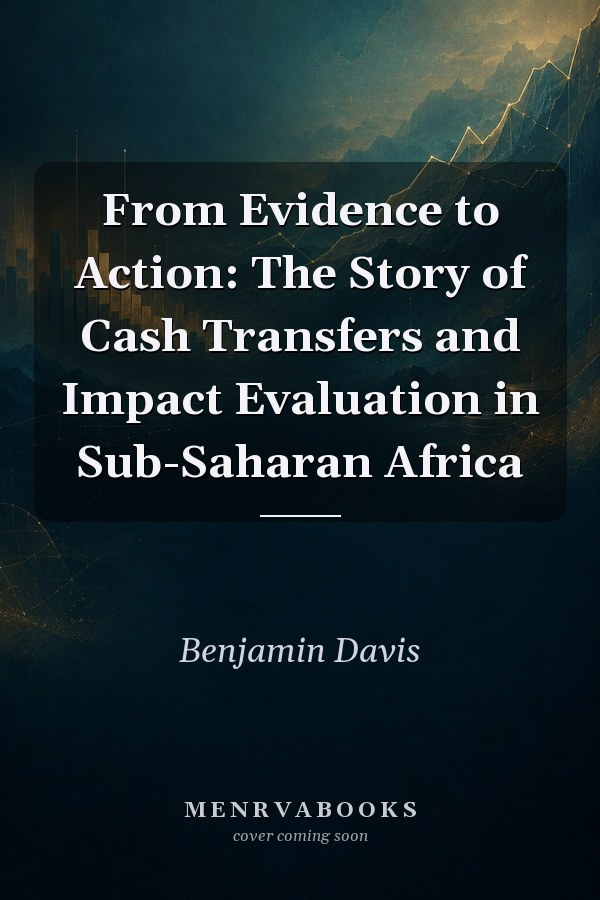
From Evidence to Action: The Story of Cash Transfers and Impact Evaluation in Sub-Saharan Africa
0
0
As an Amazon Associate and affiliate partner, Menrva Books earns from qualifying purchases. Learn more
Author Description
Impact evaluations must be embedded in the ongoing process of policy and programme design in order to be effective in influencing country policy. This is the primary lesson found in this book, which is based on the rigorous impact evaluations and country-case study analysis of government-run cash transfer programmes undertaken in eight Sub-Saharan African countries (Kenya, Ghana, Ethiopia, Zambia, Zimbabwe, Lesotho, Malawi, South Africa) evaluated as part of the Transfer Project and From Protection to Production Project. The impact evaluations employed mixed method approaches, including randomized controls trials (RCTs) and non-experimental designs, qualitative methods and village LEWIE-CGE modelling. Evidence presented in the book counteracts concerns around social protection creating dependency showing that unconditional cash transfers lead to a broad range of social and productive impacts, even though they are not tied to any specific behaviour.
Menrva's Summary
THE THESIS
This book investigates how rigorous impact evaluations can be integrated into the design and implementation of government-run cash transfer programs to effectively influence national policy. The authors, Benjamin Davis, Nicola Hypher, and Sudhanshu Handa, draw upon their extensive research experience within the Transfer Project and the From Protection to Production Project. They present a comprehensive framework that utilizes empirical data to challenge the assumption that unconditional cash transfers foster dependency, arguing instead that these programs generate significant social and productive benefits.
THE SCOPE MAP
What You Will Find
- Longitudinal impact evaluations of government-run cash transfer programs across eight Sub-Saharan African nations.
- Application of mixed-method research designs including randomized control trials (RCTs) and non-experimental methods.
- Utilization of village-level LEWIE-CGE modeling to assess local economic impacts.
Scope Limits
- The analysis is restricted to the specific government-run programs evaluated within the Transfer Project and From Protection to Production Project frameworks.
- The text does not provide a general guide to all forms of international aid or non-governmental social safety nets.
THE AUTHORITY PERSPECTIVE
Experts in development economics recognize this work as a critical synthesis of evidence-based policy implementation in the African context. Readers frequently note the technical density of the methodology, making it a primary resource for policy analysts and researchers focused on social protection programs.
Page Count:
352
Publication Date:
2016-01-01
Publisher:
OUP Oxford
ISBN-10:
0191082279
ISBN-13:
9780191082276
Economics
Public Policy
Principles of Microeconomics
Social Protection
Financial Accounting
Community Tags
Similar Books