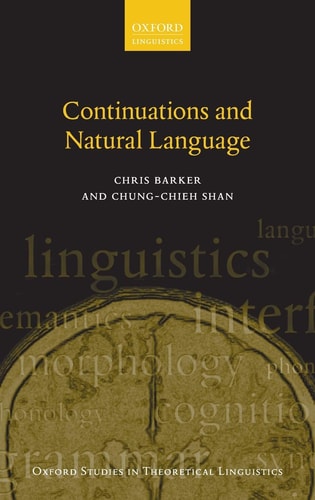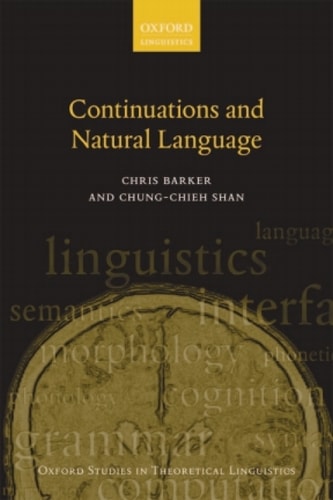
Continuations and Natural Language
0
0
As an Amazon Associate and affiliate partner, Menrva Books earns from qualifying purchases. Learn more
Author Description
This book takes concepts developed by researchers in theoretical computer science and adapts and applies them to the study of natural language meaning. Summarizing more than a decade of research, Chris Barker and Chung-chieh Shan put forward the Continuation Hypothesis: that the meaning of a natural language expression can depend on its own continuation. In Part I, the authors develop a continuation-based theory of scope and quantificational binding and provide an explanation for order sensitivity in scope-related phenomena such as scope ambiguity, crossover, superiority, reconstruction, negative polarity licensing, dynamic anaphora, and donkey anaphora. Part II outlines an innovative substructural logic for reasoning about continuations and proposes an analysis of the compositional semantics of adjectives such as 'same' in terms of parasitic and recursive scope. It also shows that certain cases of ellipsis should be treated as anaphora to a continuation, leading to a new explanation for a subtype of sluicing known as sprouting. The book makes a significant contribution to work on scope, reference, quantification, and other central aspects of semantics and will appeal to semanticists in linguistics and philosophy at graduate level and above.
Menrva's Summary
THE THESIS
This book investigates the Continuation Hypothesis, which posits that the meaning of a natural language expression is fundamentally dependent on its own continuation. Authors Chris Barker and Chung-chieh Shan, both established researchers in the field, synthesize over a decade of work to bridge theoretical computer science concepts with formal semantics. They propose a rigorous framework that utilizes continuation-based logic to resolve complex issues in scope, quantification, and anaphora.
THE SCOPE MAP
What You Will Find
- A continuation-based theory of scope and quantificational binding.
- An innovative substructural logic for reasoning about linguistic continuations.
- Formal analyses of scope ambiguity, crossover, superiority, and negative polarity licensing.
- A compositional semantic analysis of adjectives like 'same' using parasitic and recursive scope.
Scope Limits
- The text is restricted to advanced theoretical linguistics and formal semantics.
- It does not provide an introductory overview of general linguistic principles.
THE AUTHORITY PERSPECTIVE
Experts recognize this work as a foundational text for graduate-level semanticists and philosophers of language. Readers frequently note the high level of technical density and the specialized nature of the formal logic employed throughout the chapters.
Page Count:
320
Publication Date:
2014-01-01
Publisher:
OUP Oxford
ISBN-10:
0191664928
ISBN-13:
9780191664922
Computational linguistics
English & College Success
Linguistics
Semantics
English
Philosophy of
Theoretical Linguistics