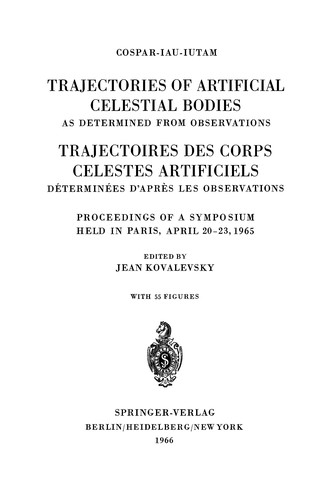
Trajectories of Artificial Celestial Bodies as Determined from Observations
0
0
As an Amazon Associate and affiliate partner, Menrva Books earns from qualifying purchases. Learn more
Author Description
This book is a comprehensive treatise on the determination of the trajectories of artificial celestial bodies from observational data. It covers the fundamental principles of celestial mechanics and the practical methods used to derive orbital elements from ground-based and space-based observations. The text delves into the various factors that influence these trajectories, including gravitational forces, atmospheric drag, and solar radiation pressure, and presents the mathematical techniques required to model and predict them accurately. It is intended for advanced students and researchers in astrodynamics, aerospace engineering, and astronomy.
Menrva's Summary
THE THESIS
This book investigates the methods and challenges in determining the orbital paths of artificial satellites based on observational data. It addresses the complexities arising from imperfect measurements, atmospheric drag, and gravitational perturbations, presenting mathematical frameworks and computational techniques essential for accurate trajectory prediction. The work is grounded in the principles of celestial mechanics and observational astronomy, aiming to provide a rigorous treatment for specialists in the field.
THE SCOPE MAP
- Methods for processing observational data from artificial celestial bodies.
- Mathematical models for calculating orbital trajectories.
- Analysis of perturbations affecting satellite orbits (e.g., atmospheric drag, gravitational anomalies).
- Techniques for determining orbital elements from positional observations.
- Discussion of the historical context and evolution of astrodynamics.
- Application of these principles to specific satellite missions or types.
THE AUTHORITY PERSPECTIVE
This work is recognized as a foundational text in the field of astrodynamics, particularly for its detailed treatment of observational methods in determining satellite trajectories. Its rigorous mathematical approach and comprehensive coverage of perturbation effects have made it a valuable resource for researchers and students. The book is noted for its depth, appealing to those with a strong background in celestial mechanics and applied mathematics. Its enduring relevance lies in the fundamental principles it establishes for understanding and predicting the motion of artificial bodies in space.
Page Count:
0
Publication Date:
1966-01-01
ISBN-10:
3642493289
ISBN-13:
9783642493287
Science
Non-Fiction
Astronomy
Astrodynamics
Community Tags
Similar Books