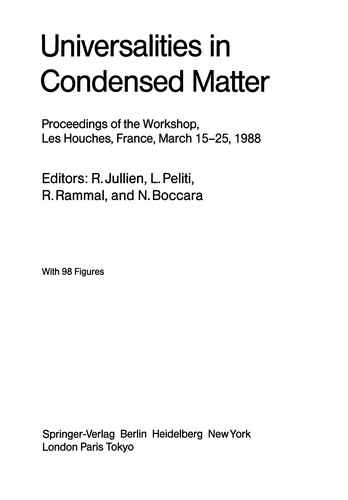
Universalities in Condensed Matter
0
0
As an Amazon Associate and affiliate partner, Menrva Books earns from qualifying purchases. Learn more
Author Description
Universality is the property that systems of radically different composition and structure exhibit similar behavior. The appearance of universal laws in simple critical systems is now well established experimentally, but the search for universality has not slackened. This book aims to define the current status of research in this field and to identify the most promising directions for further investigations. On the theoretical side, numerical simulations and analytical arguments have led to expectations of universal behavior in several nonequilibrium systems, e.g. aggregation, electric discharges, and viscous flows. Experimental work is being done on "geometric" phase transitions, e.g. aggregation and gelation, in real systems. The contributions to this volume allow a better understanding of chaotic systems, turbulent flows, aggregation phenomena, fractal structures, and quasicrystals. They demonstrate how the concepts of renormalization group transformations, scale invariance, and multifractality are useful for describing inhomogeneous materials and irreversible phenomena.
Menrva's Summary
THE THESIS
The concept of universality posits that diverse systems, regardless of their specific composition or structure, can exhibit remarkably similar behaviors. This book, edited by Rémi Jullien, synthesizes current research on universality in condensed matter physics. It explores both established experimental findings in simple critical systems and ongoing investigations into more complex phenomena. The work highlights theoretical expectations of universal behavior in nonequilibrium systems, such as aggregation and fluid dynamics, alongside experimental studies of geometric phase transitions.
THE SCOPE MAP
- An exploration of universality in condensed matter systems.
- Discussion of theoretical and experimental approaches to universality.
- Coverage of nonequilibrium systems including aggregation, electric discharges, and viscous flows.
- Examination of geometric phase transitions in real systems.
- Insights into chaotic systems, turbulent flows, aggregation phenomena, fractal structures, and quasicrystals.
- Application of concepts like renormalization group transformations, scale invariance, and multifractality.
- Analysis of inhomogeneous materials and irreversible phenomena.
THE AUTHORITY PERSPECTIVE
This collection of contributions aims to define the current status of research in universality and identify promising future directions. The volume demonstrates the utility of concepts such as renormalization group transformations, scale invariance, and multifractality for describing complex materials and processes. It bridges theoretical expectations from numerical simulations and analytical arguments with ongoing experimental work. The book serves as a resource for understanding chaotic systems, turbulent flows, aggregation, fractals, and quasicrystals.
Page Count:
257
Publication Date:
1988-01-01
ISBN-10:
3642510051
ISBN-13:
9783642510052
Non-Fiction
Science
Statistical mechanics
Fractals
Physics
Chaos Theory
Community Tags
Similar Books