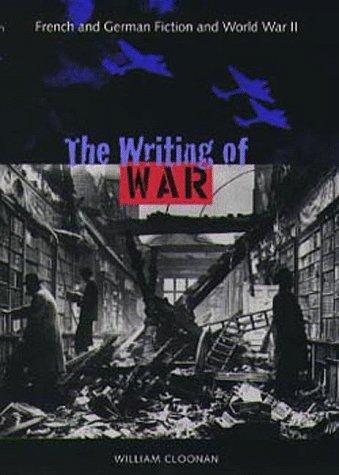
The Writing of War
0
0
As an Amazon Associate and affiliate partner, Menrva Books earns from qualifying purchases. Learn more
Author Description
In a major reevaluation of how World War II affected the writing of literature in France and Germany, William Cloonan argues that many established writers (Thomas Mann, Ernst Junger, Albert Camus, Jean-Paul Sartre) were unsuccessful in their attempts to write about the war precisely because they refused to confront the ways in which this conflict was so radically different from previous wars. In particular, atrocities such as the Nazis' Final Solution, the atomic devastation of Japan, and the bombings of civilian populations called into question the moral and intellectual framework that had shaped Western thinking; throughout Europe, the heritage of the Enlightenment seemed to collapse. Combining literary history and textual analyses, Cloonan turns to efforts by younger artists in France and Germany to rethink the approach to literature in a postwar context, devoting attention to Group 47 (Germany) and the New Novelists (France).
Menrva's Summary
THE THESIS
This book reevaluates the impact of World War II on literature in France and Germany, arguing that established writers struggled to capture the war's unique nature. Cloonan posits that the unprecedented atrocities of the era, such as the Holocaust and atomic bombings, fundamentally challenged the Western moral and intellectual framework inherited from the Enlightenment. The work then examines how younger artists in both nations, through movements like Germany's Group 47 and France's New Novelists, sought to redefine literary approaches in the postwar period.
THE SCOPE MAP
- Analysis of established writers' attempts to depict World War II in France and Germany, including Thomas Mann, Ernst Junger, Albert Camus, and Jean-Paul Sartre.
- Exploration of how atrocities like the Final Solution and atomic devastation questioned the Western intellectual heritage.
- Focus on the literary responses of younger artists in postwar France and Germany.
- Detailed examination of Group 47 in Germany and the New Novelists in France.
- Combination of literary history and textual analysis.
THE AUTHORITY PERSPECTIVE
William J. Cloonan's "The Writing of War" offers a significant reevaluation of how World War II influenced literary production in France and Germany. The book's central argument suggests that many prominent writers of the time failed to adequately represent the conflict due to their inability to grasp its radical departure from prior wars. By analyzing the works of both established and emerging authors, Cloonan highlights the profound crisis in Western thought prompted by the war's unprecedented horrors and explores the subsequent literary innovations that sought to grapple with this new reality.
Page Count:
188
Publication Date:
1999-01-01
ISBN-10:
0813016851
ISBN-13:
9780813016856
Fiction
History
Non-Fiction
Literary Criticism
Community Tags
Similar Books