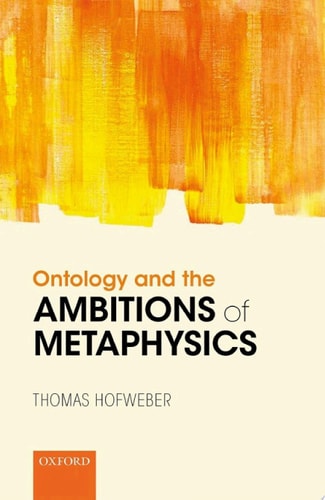
Ontology and the Ambitions of Metaphysics
0
0
As an Amazon Associate and affiliate partner, Menrva Books earns from qualifying purchases. Learn more
Author Description
Many significant problems in metaphysics are tied to ontological questions, but ontology and its relation to larger questions in metaphysics give rise to a series of puzzles that suggest that we don't fully understand what ontology is supposed to do, nor what ambitions metaphysics can have for finding out about what reality is like. Thomas Hofweber aims to solve these puzzles about ontology and consequently to make progress on four central metaphysical problems: the philosophy of arithmetic, the metaphysics of ordinary objects, the problem of universals, and the question of whether the reality is independent of us. Crucial parts of the proposed solution involve considerations about quantification and its relationship to ontology, the place of reference in natural languages, the possibility of ineffable facts, the extent of empirical evidence in metaphysics, and whether metaphysics can be properly esoteric. Overall, Hofweber defends a rationalist account of arithmetic, an empiricist picture in the philosophy of ordinary objects, a restricted form of nominalism, and realism about reality, understood as all there is, but idealism about reality, understood as all that is the case. He defends metaphysics as having some questions of fact that are distinctly its own, with a limited form of autonomy from other parts of inquiry, but rejects several metaphysical projects and approaches as being based on a mistake.
Menrva's Summary
THE THESIS
This work investigates the fundamental nature of ontology and its capacity to address core metaphysical inquiries regarding the structure of reality. Thomas Hofweber, a professor of philosophy, utilizes a framework rooted in the philosophy of language and logic to resolve persistent puzzles surrounding ontological commitment. By examining the relationship between quantification and existence, he argues for a nuanced approach that distinguishes between different metaphysical projects, ultimately seeking to clarify what metaphysics can legitimately claim to know about the world.
THE SCOPE MAP
What You Will Find
- An analysis of the relationship between quantification and ontological commitment
- A rationalist account of arithmetic and an empiricist view of ordinary objects
- A defense of restricted nominalism and a dualistic perspective on reality
- Investigations into the limits of empirical evidence in metaphysical inquiry
Scope Limits
- The text does not provide a comprehensive history of metaphysical thought
- It does not address theological or ethical dimensions of metaphysics
THE AUTHORITY PERSPECTIVE
Scholars and students of analytic philosophy frequently note the high level of technical density and the rigorous logical argumentation present throughout the text. Experts highlight this work as a significant contribution to contemporary debates on the methodology and boundaries of metaphysical inquiry.
Page Count:
381
Publication Date:
2016-01-01
Publisher:
OUP Oxford
ISBN-10:
0191091251
ISBN-13:
9780191091254
Philosophy
Metaphysics
Epistemology
Philosophy of
Logic
Ontology
Community Tags
Other Editions(4)


Similar Books









Reader Comments
Share Your Thoughts
No comments yet. Be the first to share your thoughts!