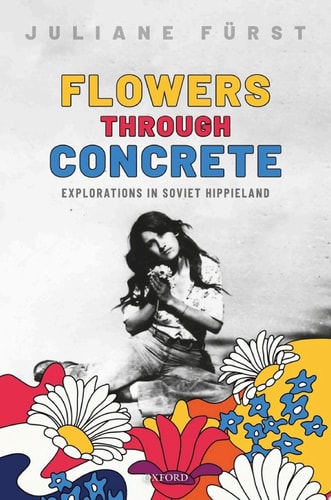
Flowers Through Concrete: Explorations in Soviet Hippieland
0
0
As an Amazon Associate and affiliate partner, Menrva Books earns from qualifying purchases. Learn more
Author Description
Flowers through Concrete: Explorations in Soviet Hippieland does what the title promises. It takes readers on a journey into a world few knew existed: the lives and thoughts of Soviet hippies, who in the face of disapproval and repression created a version of Western counterculture, skilfully adapting, manipulating, and shaping it to their late socialist environment. As a quasi-guide into the underground hippieland, readers are situated in the world of hippies firmly in late Soviet reality and are offered an unusual history of the last Soviet decades as well as a case study in the power of transnational youth cultures. Flowers through Concrete recounts not only a compelling story of survival against the odds-hippies were harassed by police, shorn of their hair by civilian guards, and confined in psychiatric hospitals by doctors who believed non-conformism was a symptom of schizophrenia. It also advances a surprising argument: despite obvious antagonism the land of Soviet hippies and the world of late socialism were not incompatible. Indeed, Soviet hippies and late socialist reality meshed so well that the hostile, yet stable, relationship that emerged was in many ways symbiotic. Ultimately, it was not the KGB but the arrival of capitalism in the 1990s that ended the Soviet hippie sistema.
Menrva's Summary
THE THESIS
This book investigates how Soviet hippies navigated, adapted, and coexisted with the late socialist state despite intense official repression. Juliane Fürst, a historian specializing in Soviet youth culture, utilizes extensive archival research and oral history interviews to argue that the hippie movement was not merely an oppositional force but a subculture that developed a symbiotic relationship with the Soviet system. She posits that the movement's survival and eventual decline were tied more to the transition to capitalism than to direct state eradication.
THE SCOPE MAP
What You Will Find
- Analysis of the 'sistema' or underground network of Soviet hippies.
- Examination of state responses, including police harassment and psychiatric institutionalization.
- Primary source accounts from participants in the late Soviet counterculture.
Scope Limits
- The study focuses primarily on the late Soviet period and does not provide an exhaustive history of all Soviet youth movements.
- It does not attempt to cover the post-Soviet diaspora of these individuals in significant detail.
THE AUTHORITY PERSPECTIVE
Scholars and historians recognize this work as a significant contribution to the study of late Soviet social history and transnational youth movements. Readers frequently note the academic rigor of the research while appreciating the author's ability to synthesize complex political dynamics with personal narratives.
Page Count:
495
Publication Date:
2021-01-01
Publisher:
OUP Oxford
ISBN-10:
0191092517
ISBN-13:
9780191092510
History
Counterculture
Youth Culture
Social History
Modern History
Europe
European History
Soviet Union
Community Tags
Similar Books