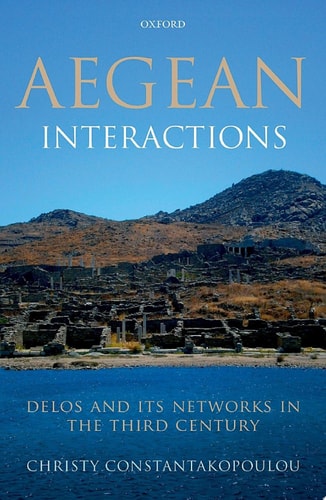
Aegean Interactions: Delos and its Networks in the Third Century
0
0
As an Amazon Associate and affiliate partner, Menrva Books earns from qualifying purchases. Learn more
Author Description
The third century BC was a particularly troubled period of ancient Greek history, when the Aegean sea became the main stage for power struggles between various royal circles and dynasties, including the Antigonids and the Ptolemies. This volume addresses the history of interaction in the Aegean world during this time by focusing on the island of Delos, which housed one of its most important regional sanctuaries. It draws on contemporary network theory and approaches to regionalism, as well as thorough investigation of the Delian epigraphic and material evidence, to explore how and to what degree the islands of the southern Aegean formed active networks of political, religious, and cultural interaction. Four case studies examine different types of networks on and around Delos, covering the federal organisation of islands into the so-called 'Islanders' League', the participation of Delian and other agents in the processes of monumentalisation of the Delian landscape, the network of honours of the Delian community, and the social dynamics of dedication through the record of dedicants in the Delian inventories. They reveal not only that these kinds of regional interaction in the southern Aegean were pervasive, but also that they had a significant impact on the creation of a regional identity; one that persisted despite the political changes of the age.
Menrva's Summary
THE THESIS
This volume investigates how the island of Delos functioned as a central node for political, religious, and cultural interaction within the southern Aegean during the third century BC. Christy Constantakopoulou, a scholar specializing in Aegean history, utilizes contemporary network theory and regionalism frameworks to analyze the connectivity of the Cyclades. By synthesizing epigraphic and material evidence, the author argues that these islands maintained active, pervasive networks that fostered a distinct regional identity despite the volatile power struggles between Hellenistic dynasties.
THE SCOPE MAP
What You Will Find
- Analysis of the Islanders' League and federal island organizations.
- Examination of monumentalization processes within the Delian landscape.
- Study of the network of honors and social dynamics of dedications.
- Application of network theory to Hellenistic epigraphic data.
Scope Limits
- The study focuses primarily on the southern Aegean and Delos, excluding broader analysis of mainland Greek or western Mediterranean political structures.
- The research is confined to the third century BC, omitting earlier or later developments in Delian history.
THE AUTHORITY PERSPECTIVE
Scholars and historians frequently cite this work as a significant contribution to the application of network theory in classical archaeology. Readers often note the academic density of the prose, which requires a foundational understanding of Hellenistic history to fully appreciate the author's methodological arguments.
Page Count:
349
Publication Date:
2017-01-01
Publisher:
OUP Oxford
ISBN-10:
0191091170
ISBN-13:
9780191091179
History
Archaeology
English & College Success
Greece
English
Aegean islands greece and turkey
Ancient Greece
Network Theory
Community Tags
Similar Books