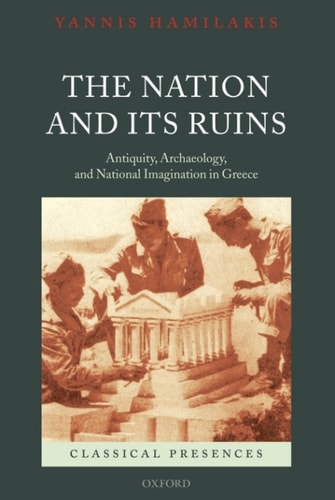
The Nation and its Ruins: Antiquity, Archaeology, and National Imagination in Greece
0
0
As an Amazon Associate and affiliate partner, Menrva Books earns from qualifying purchases. Learn more
Author Description
This innovative, extensively illustrated study examines how classical antiquities and archaeology contributed significantly to the production of the modern Greek nation and its national imagination. It also shows how, in return, national imagination has created and shaped classical antiquities and archaeological practice from the nineteenth century to the present. Yannis Hamilakis covers a diverse range of topics, including the role of antiquities in the foundation of the Greek state in the nineteenth century, the Elgin marbles controversy, the role of archaeology under dictatorial regimes, the use of antiquities in the detention camps of the Greek civil war, and the discovery of the so-called tomb of Philip of Macedonia.
Menrva's Summary
THE THESIS
How do classical antiquities and the practice of archaeology function as active agents in the construction and maintenance of the modern Greek national identity? Yannis Hamilakis, a professor of archaeology, utilizes a critical, post-colonial, and reflexive framework to analyze the intersection of material culture and state-building. By examining the historical trajectory of Greek archaeology from the nineteenth century to the contemporary era, he argues that the nation-state and its archaeological heritage are mutually constitutive, each shaping the other through political and social discourse.
THE SCOPE MAP
What You Will Find
- Historical analysis of the foundation of the Greek state and its reliance on antiquity.
- Examination of the Elgin marbles controversy as a symbol of national identity.
- Case studies on the use of archaeology under various political regimes, including dictatorships.
- Investigation into the politicization of archaeological sites, such as detention camps and royal tombs.
Scope Limits
- The text does not provide a comprehensive archaeological history of Greece, focusing instead on the socio-political use of the discipline.
- It does not offer a neutral or purely descriptive account of archaeological discoveries, prioritizing critical theory over technical excavation reports.
THE AUTHORITY PERSPECTIVE
Scholars in the field of heritage studies and Mediterranean history frequently cite this work as a foundational text for understanding the political dimensions of archaeology. Readers often note the academic density of the prose, which requires a familiarity with critical theory and modern Greek history to fully appreciate the author's arguments.
Page Count:
360
Publication Date:
2007-01-01
Publisher:
Oxford University Press
ISBN-10:
0191528129
ISBN-13:
9780191528125
History
Archaeology
Greece
English
Modern Greek
Cultural Anthropology
English & College Success
Nationalism
Community Tags
Similar Books