The Fortifications of Arkadian City States in the Classical and Hellenistic Periods
0
0
As an Amazon Associate and affiliate partner, Menrva Books earns from qualifying purchases. Learn more
Author Description
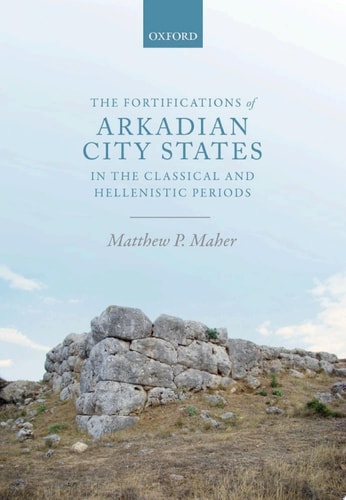
This illustrated study comprises a comprehensive and detailed account of the historical development of Greek military architecture and defensive planning, specifically in Arkadia in the Classical and Hellenistic periods. Employing data gathered from the published literature, and collected during the field reconnaissance of every site, the fortification circuit of each Arkadian polis is explored. In this way, the book provides an accurate chronology for the walls in question; an understanding of the relationship between the fortifications and the local topography; a detailed inventory of all the fortified poleis of Arkadia; a regional synthesis based on this inventory; and the probable historical reasons behind the patterns observed through the regional synthesis. Maher argues that there is no evidence for fortified poleis in Arkadia during the Archaic period. However, when the poleis were eventually fortified in the Classical period, the fact that most appeared in the early fourth century BC, strategically distributed in limited geographic areas, suggests that the larger defensive concerns of the Arkadian League were a factor. Although the defensive responses to innovations in siege warfare and offensive artillery of the Arkadian fortifications follow the same general developments observable in the circuits found throughout the Greek world, there does exist a number of interesting and noteworthy, regionally specific, patterns. Such discoveries validate the methodology employed and clearly demonstrate the value of an exclusively regional focus for shedding light on a number of architectural, topographical, and historic issues.
Menrva's Summary
THE THESIS
This study investigates the historical development and strategic purpose of military fortifications within the Arkadian city-states during the Classical and Hellenistic periods. Matthew P. Maher, utilizing extensive field reconnaissance and existing archaeological literature, constructs a chronological framework for these defensive structures. He argues that the emergence of these fortifications was not a uniform process but was instead driven by the specific defensive requirements of the Arkadian League and regional geopolitical pressures.
THE SCOPE MAP
What You Will Find
- A comprehensive inventory of fortified poleis in the Arkadian region.
- Analysis of the relationship between defensive architecture and local topography.
- Chronological mapping of wall construction from the Classical to the Hellenistic period.
- Comparative analysis between regional Arkadian patterns and broader Greek military developments.
Scope Limits
- The study does not provide evidence for fortified poleis in Arkadia during the Archaic period.
- The analysis is geographically restricted to the Arkadian region rather than the entirety of the Greek world.
THE AUTHORITY PERSPECTIVE
Experts recognize this work as a rigorous regional study that successfully challenges broader generalizations about ancient Greek military architecture. Scholars frequently note the value of Maher's field-based methodology in providing a granular understanding of how local topography influenced defensive planning.
Page Count:
432
Publication Date:
2017-01-01
Publisher:
OUP Oxford
ISBN-10:
0191090212
ISBN-13:
9780191090219
History
Architecture
English
English & College Success
Archaeology
Military History
Ancient Greece